
In this article
If you've never bought hair extensions before, the category can feel like it's speaking a language you were never taught. Texture, method, color rings, grams, single-drawn, cuticle-intact — every product page seems to assume you already know what you want.
You don't have to. After about a decade sourcing single-donor Indian hair, I can tell you the people who end up happiest aren't the ones who knew the most going in. They're the ones who took the decisions one at a time, in order. That's all this guide is: five small, calm decisions, each with a deeper post to lean on if you want it, and a $10 sample at the end so your first real order is a sure thing — not a leap of faith.
Here's the whole path before we walk it. Pick your texture, pick your method, match your color, choose your length, then confirm with a sample. That's it. Let's take them one by one.
A quick word on quality, so you can relax
Before the steps, one reassurance — because most first-timer anxiety is really about this: will the hair be good?
Everything we make starts from single-donor, cuticle-intact human hair — gathered from one person, with the cuticle layer kept on and naturally aligned, never acid-washed and re-coated to fake smoothness. That's the difference between hair that stays smooth and reflective for years and hair that tangles once its silicone coating washes off. You don't need to memorize the chemistry. You just need to know that the quality question is already answered, so you can spend your attention on the five fit decisions below. If you'd like the full map of the category first, Hair Extensions 101 lays out every type and how to read it.
Step 1 — Pick your texture
Start here, because texture is what makes extensions disappear into your own hair. The goal is simple: match the pattern your hair has when it's air-dried and left alone — straight, a natural wave, or a curl — rather than the pattern you create with a tool each morning.
A quick reassurance about textured hair: patterns like body wave, loose curl, and kinky curl are steam-set from genuine human hair, not printed onto a fiber. That's a sign the hair is real, not a downgrade — and it's why we always recommend confirming texture with a strand in hand before you commit. We walk through how to read your own pattern, and how to choose, in How to Choose the Right Hair Extension Texture.
Step 2 — Pick your method
Now decide how the hair attaches to your head. This is less about the hair and more about your life — how permanent you want it, whether a stylist is involved, and how much you want to do yourself.
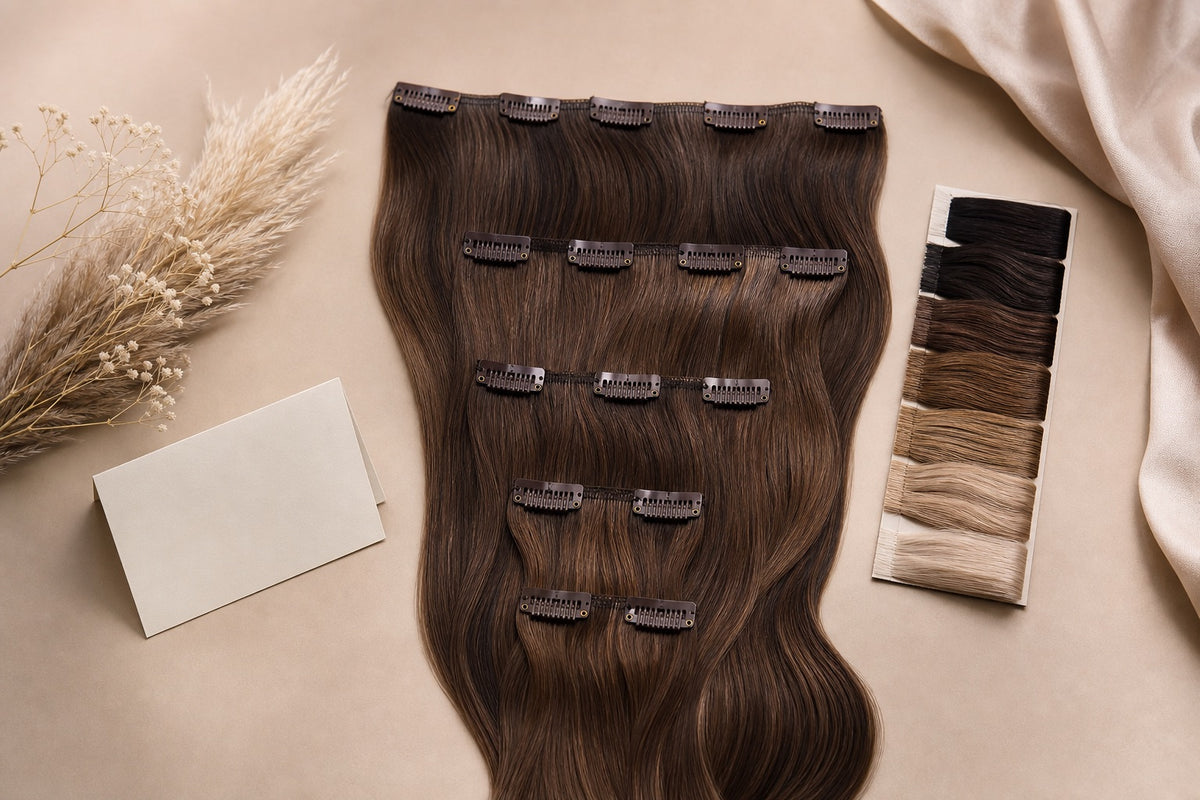
The short version: clip-ins go in and out in minutes with no professional and no commitment, which makes them the gentlest place for a first-timer to start. Tape-ins are lightweight and semi-permanent, fitted by a stylist. Sew-ins are sturdy and long-wearing. Micro-links attach strand by strand with no heat or glue. None is "best" in the abstract — the right one is the one that fits your routine. We compare all four, with the trade-offs laid out plainly, in Clip-In vs. Tape-In vs. Sew-In vs. Micro-Link.
Step 3 — Match your color
This is the step that decides whether extensions read as yours or as something added on — and it's the one most worth slowing down for. The trap is judging color off a screen. Lighting on a phone lies; brightness, white balance, and your room's light all shift what you see. The strand in your hand never does.
A couple of things that make matching easier: pick the shade your hair is at the mid-lengths and ends, where extensions actually sit, not at the roots. And remember that real single-donor hair carries gentle, natural variation from donor to donor — a faint difference between two wefts of the same shade is a fingerprint of genuine hair, not a defect, and it blends into a more believable, dimensional result. We cover how to do this at your bathroom mirror — and how to use our color-match help — in How to Color-Match Hair Extensions at Home.
Step 4 — Choose your length
Length is where a small piece of knowledge saves a lot of disappointment, so it's worth thirty seconds.
All real hair is measured pulled straight — that's the industry standard. But hair with a wave or curl doesn't wear at its straightened length; the pattern takes up length, so it falls a little shorter once it's in. The practical rule: if you have a specific finished length in mind and your hair is textured, choose a length a little longer than the number you're picturing — and the tighter the pattern, the more you size up. Beyond that, think about where you want the hair to fall on your body and how that suits your day-to-day. We go through choosing a flattering length, and the texture take-up, in What Length Hair Extensions Should You Choose.
Step 5 — Confirm with a $10 sample before the full order
Here's where confidence actually comes from. You've made four good decisions on paper. Before you place a full order, you turn those decisions into something you can hold.
A $10 sample lets you see the real texture, feel the real weight, and match the real color against your own hair in your own light — the one test a screen can never pass. You confirm the four choices above are right before you've committed to a full set. That's the entire point: it removes the guesswork from the only order that matters.
If you're not yet sure how much hair a full look will need, that's a separate, easy question — coverage, length, and texture decide it, and we walk through estimating it in How Much Hair Do You Actually Need?. But you don't need that settled to take the first step. Sample first; size the full order once you've felt the hair.
The whole path, on one line
- Texture — match your natural, air-dried pattern.
- Method — pick what fits your life; clip-ins are the gentlest start.
- Color — match at the mid-lengths and ends, in real light, never a screen.
- Length — size up for textured hair to land your finished look.
- Confirm — a $10 sample turns four good guesses into one sure order.
That's the move from confused to confident: not learning everything at once, but taking five small decisions in order — and proving them with a strand in your hand before the order that counts. Quality is already handled; your only job is fit, and fit is something you can feel.
So if you take one thing from this guide, let it be the first step. Don't order a full set on faith. Order a $10 shade-and-texture sample →, hold the real hair against your own, and let the sample tell you you're right. That's where confident first orders begin.
Written from the Prarvi workbench by Preeti Gupta — chemical engineer and founder, with about a decade sourcing single-donor Indian hair. I'd rather you start with a $10 sample and be sure than spend more and hope.
