
In this article
“Hair extensions” is one phrase doing far too many jobs. It covers a $10 sample and a full custom unit, hair that lasts a decade and hair that tangles in a month. No wonder the category feels confusing.
Here's a map. Almost every extension can be described by answering three separate questions — and the biggest mistake buyers make is treating them as one.
The three questions that describe any extension
- What is the hair itself? Its texture, its colour, and where it actually came from.
- How is it built? The form — a weft, a clip-in set, a closure, a wig, and so on.
- How does it attach? The install method — sewn in, beaded, taped, bonded, clipped.
These don't line up one-to-one. The same weft can be sewn in, beaded, or glued. A great colour match means nothing if the form is wrong for the client, and the most clever install can't fix poor-quality hair. Read all three and you'll never be surprised by an order.
Want the full map? See our complete guide to hair — source, grade, processing, texture, form and install, all in one place.
Question 2, first: the forms (what it physically is)
It's easiest to picture the forms, so let's start there. The common groupings:
- Wefts (sets). Hair sewn along a top seam, sold by length and weight. The workhorse of the industry — sewn in, beaded, or glued for a long-wear install. (Searching “bundles”? A bundle is just a weft.)
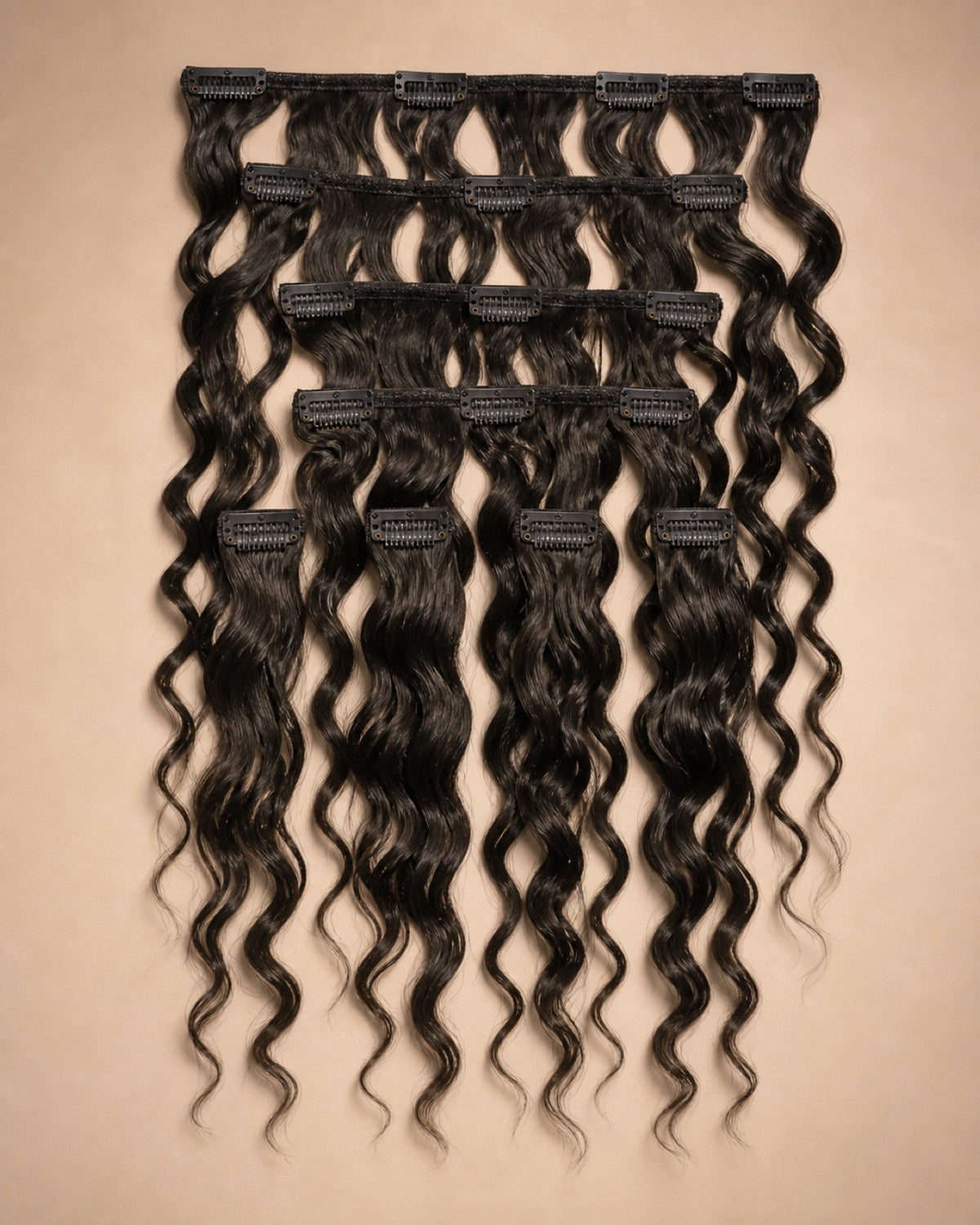
- Clip-in sets. Wefts with clips attached — temporary, no professional needed, in and out in minutes. Great for volume and occasion wear.
- Tape-ins. Thin wefts pre-taped to sandwich onto your own hair. Fast for a stylist, lightweight, semi-permanent.
- I-tips / tip extensions. Small individual strands attached one section at a time — by a micro-link bead or a keratin bond. The most natural movement, the most labour. Read the complete i-tip guide.
- Ponytails & volumizers. Single-purpose pieces — a wrap-around ponytail, or a clip-in panel that adds fullness through the crown.
- Closures & frontals. Lace pieces that finish a sew-in install with a realistic part and hairline, so no leave-out is needed — closures for the crown, frontals for the full hairline.
- Toppers & hairpieces. Worn at the crown to add coverage and density where your own hair has thinned — a cosmetic coverage piece, not a treatment.
- Wigs. Full coverage on a cap. The whole look, on and off in one piece.
Which form is right is a function of how much coverage you need, how permanent you want it, and whether a professional is installing it.
How they attach (the install method)
The same hair can go on several ways — this is the axis people most often conflate with the form:
- Sew-in (braid-down). Wefts stitched to braided hair. Sturdy, protective, long-wear.
- Micro-link / bead. Strands or wefts secured with a tiny silicone-lined ring — no heat, no glue, fully repositionable.
- Keratin fusion. I-tips bonded with a keratin tip — seamless and durable, removed with a solution.
- Tape. Adhesive wefts sandwiched onto the hair — quick, flat, comfortable.
- Glue / bond. Wefts or a unit bonded to the hairline or track for short-term wear.
- Clip. Temporary, do-it-yourself, zero commitment.
One form, several methods: a weft can be sewn, beaded, or glued; an i-tip can be beaded or fused. That flexibility is why we keep “form” and “install” as separate decisions.
Where the hair comes from — and what's been done to it
This is the question that actually decides quality, and the one the industry is vaguest about. Two things matter: the source, and the processing.
Source — start with the cuticle. Each strand has a cuticle layer that all faces one direction on a real head. Keep it intact and aligned and the hair stays smooth, reflective, and tangle-free for years. There are three things sold as “human hair”:
- Genuine single-donor, cuticle-intact hair — tonsured or cut as a ponytail from one person, with the cuticle kept on and naturally aligned, never acid-washed. This is what lasts. It's what we sell.
- Comb-waste / fallen hair — collected loose, cuticles running every direction, so it's acid-stripped and silicone-coated to fake smoothness. The silicone washes off, and then it tangles.
- “Machine remy” — a branding trick: cuticles mechanically re-aligned on hair that isn't truly single-donor. Better than comb-waste, still not the real thing.
“Remy” alone doesn't tell you which of these you're holding — the whole market claims it. The honest test is cuticle-intact and gently cleansed, not acid-bathed. (We go deeper in Remy vs. Non-Remy: a buyer's guide.)
Processing — what was done to the texture and colour. Real donor hair can still be worked, and being honest about it is part of trust:
- Texture. Only three textures are truly natural: straight, natural wave, and natural curl. Every other pattern — body wave, loose curl, kinky curl, coily — is steam-set: real human hair steam-permed into a pattern. That's not a downgrade; it's the proof it's genuine hair, because the pattern gently relaxes toward its natural state after washes and is re-set with heat or steam. (A fibre with a printed-on wave never relaxes.)
- Colour. Natural means Natural Black (#1B) and genuine grey / salt-and-pepper donor hair — grey is a true virgin colour and a real rarity. Lifted/bleached covers essentially every other shade — the browns, blondes, platinum, ombré, and fashion colours are made by lifting, not grown that way. Only jet black (#1) is a true added dye. None of that is hidden in good hair; it's stated.
One more spec, not a claim: our wefts are machine-sewn (a construction fact, not a quality badge). True hand-tied work is a bespoke, special-order capability — not something to assume on a standard weft.
The part nobody warns you about: real hair varies
Here's the point that prevents the most disappointment, and it's worth saying plainly.
Natural human hair is not uniform — and that's exactly how you know it's natural. If you buy more than one weft of even the same natural shade, they can differ very slightly in colour. Natural Black #1B is not a single printed value — it varies a little from donor to donor, because it grew on different human heads. A faint variation between two wefts of #1B is a natural shade difference, not a defect.
Think about why: the only way to make every strand and every weft identical is to strip and re-dye or heavily blend the hair — which is precisely what destroys the quality you paid for. Perfect uniformity is a red flag. Gentle, natural variation is a fingerprint of genuine single-donor hair. (It's the same reason real single-donor hair tapers — see single-drawn vs. double-drawn.)
How to plan around it, like a pro:
- Buy what your project needs in one order. Wefts bought together are the closest match; reorders months later may sit a shade apart — still natural, just worth knowing.
- Alternate and blend. When you install multiple wefts, mix them across the head rather than stacking one batch on one side. Any subtle variation disappears into a natural, dimensional result.
- Expect dimension, not flatness. Real heads of hair aren't one flat colour — a little variation reads as more believable, not less.
It's the same honesty as length: textured hair is measured straight and wears shorter, and natural colour carries gentle variation. Once you expect both, real hair stops surprising you and starts impressing you.
How to choose — and what to ask
- Match the hair in your hand, not on a screen. Order a shade-and-texture sample first. Lighting lies; the real strand doesn't.
- Pick the form for the job — coverage, permanence, and who's installing.
- Size up for texture. Remember the take-up: choose a longer length on waves, curls, and coils if you want a specific finished look.
- Order your project together for the closest colour match, and blend your wefts.
- Ask the source question: cuticle-intact and single-donor, or acid-washed and coated? The answer is the whole difference.
That's the category, end to end. Get the three questions straight — what the hair is, how it's built, how it attaches — read the source and the processing honestly, and expect real hair to behave like real hair.
We're always happy to help you read it. Order a shade-and-texture sample →, see how much hair you'll need →, or talk to us about a salon order →.
Written from the Prarvi workbench by Preeti Gupta — chemical engineer and founder, with about a decade sourcing single-donor Indian hair. We'd rather explain the hair honestly than sell you a perfect-looking lie.
