
In this article
A length that looks long on one person grazes the collarbone on another. That's the thing nobody tells you before you order: an inch is a fixed measurement, but where it lands on you isn't. The same 20-inch set can read as a dramatic mid-back length on one woman and a tidy shoulder-length on another — and both bought the right hair.
So the real question isn't "which length is best." It's "which length lands where I want it, on my frame, with my texture, for my life." Once you read it that way, choosing gets a lot calmer. Here's how to do it.
First: length is measured straight — so textured hair wears shorter
Before anything else, understand how the number on the tag is set.
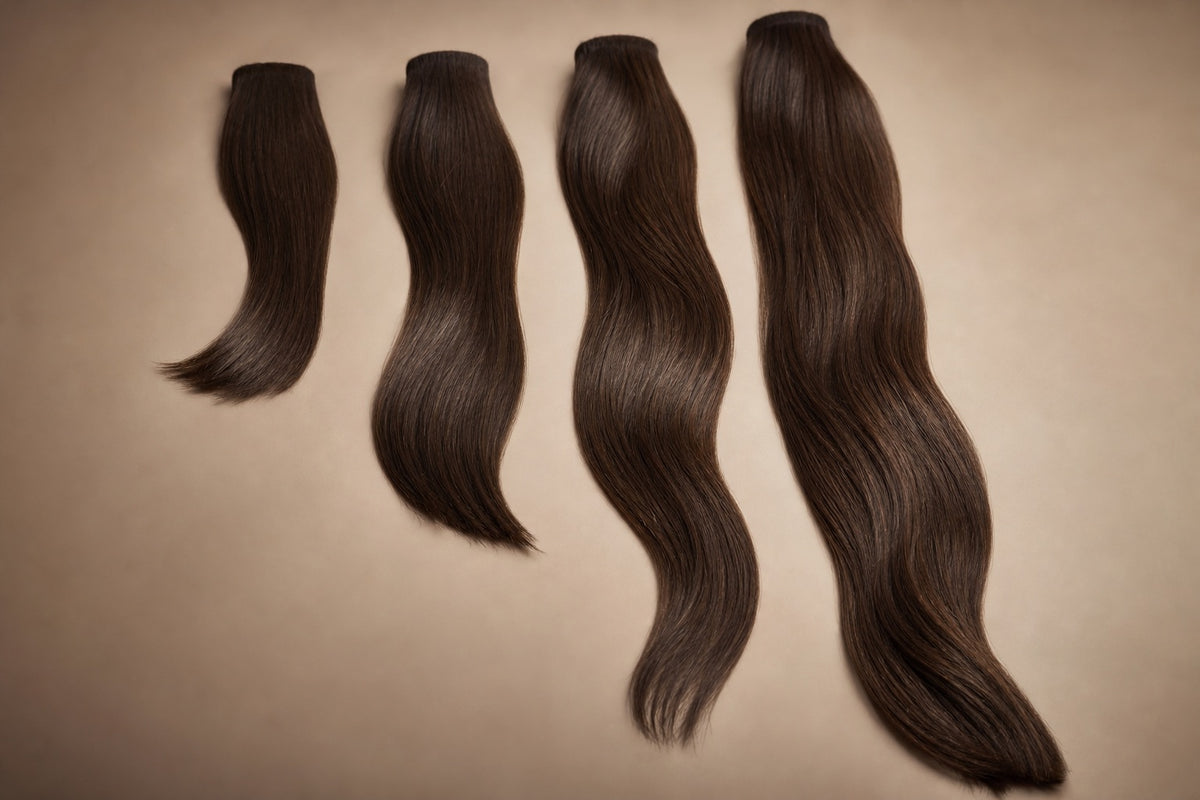
All real hair — ours and everyone's — is measured pulled straight. That's the industry standard, and it's the only honest way to measure, because every head and every pattern is different. But hair with a wave, curl, or coil doesn't wear at its straightened length. The pattern takes up length, so the hair falls shorter once it's in. A wave wears a little shorter than the tag number; a curl noticeably shorter; a tight coil significantly shorter.
That take-up isn't a flaw — it's the proof you're holding genuine patterned human hair, not a flat fiber with a wave printed on it. The practical rule: if you want a specific finished length on textured hair, choose a longer length than the number you have in mind — and the tighter the pattern, the more you size up. You'll see this same note right on our textured product pages, beside the length selector. New to the categories first? Start with Hair Extensions 101.
So every guideline below describes where a length falls on straight hair. If your set is wavy, curly, or coily, read those numbers as your minimum and size up from there.
Where each length actually falls (and why height changes it)
Here's the part the charts get wrong: they show a single silhouette, as if everyone were the same height. We're not. Extensions attach near the crown and fall from there, so the same length covers a different stretch of torso on a shorter frame than on a taller one.
Read these as a starting map for straight hair, then adjust for your height:
- 16 inches. On most frames this lands around the collarbone to just below it — shoulder-grazing on taller women, a touch lower on petite frames. The most natural, "is that even extensions?" length. Easy to wear, easy to style, blends with shorter cuts.
- 18 inches. The popular middle. Roughly between the collarbone and the top of the bust on an average height — a clear, confident length without being dramatic. On a petite frame it reads longer; on a tall frame it sits higher.
- 20 inches. Mid-chest to lower bust on most heights — the length most people picture when they think "long hair extensions." Noticeable, but still everyday.
- 22 inches and up. Mid-back territory on average heights, and genuinely long. On a petite frame this can reach toward the waist; on a tall frame it settles closer to the mid-back. This is a commitment in both look and upkeep.
The rule of thumb: the shorter you are, the longer a given length reads on you. A petite woman who wants a mid-chest finish often lands there at 18 inches, where a taller woman might need 20 to 22 for the same look. If you have a length you love on someone else, don't copy their inches — copy where it fell on them, then translate to your own height.
Reading it on your own body
You don't need anyone else's chart. Stand at a mirror and find these landmarks on yourself: collarbone, top of the bust, mid-chest, bottom of the bust, mid-back, waist. Those are the stops most lengths land on.
Now decide where you want the hair to end — not in inches, but on your body. "Just past my collarbone." "Resting at mid-chest." "Down to my waist." Then work backward to the inches, using the map above and adjusting for your height. Picking the destination first, and the number second, is the single best way to avoid the two classic regrets: ordering shorter than you pictured, or ordering so long it overwhelms you.
Face shape and proportion
Length doesn't sit in isolation — it frames your face, and a little proportion goes a long way.
- Rounder or fuller faces are usually flattered by length that falls past the chin and jaw rather than stopping at it. Length that ends right at the widest part of the face tends to draw the eye there; length that continues past it lengthens the look.
- Longer or narrower faces can carry shorter, fuller lengths beautifully — volume around the cheekbones balances the vertical line.
- Heart and oval faces are forgiving and wear most lengths well; choose by lifestyle and proportion rather than by rule.
Height matters here too. A very long length on a petite frame can visually shorten you, because the eye reads one long vertical line from crown to waist. It's not a prohibition — plenty of petite women wear waist-length hair and love it — just something to choose on purpose rather than by accident.
Lifestyle: the length you'll actually keep up
This is the honest part, and it's the one most worth sitting with: the best length is the one you'll maintain. Longer hair is more hair to detangle, dry, protect at night, and keep from catching on bag straps and seatbelts. Real human hair rewards care — and the longer it is, the more care that means.
A few practical reads:
- Active, low-fuss, or new to extensions? Start shorter — 16 to 18 inches. It blends easily, styles fast, and forgives a learning curve. You can always go longer next time.
- You style daily and enjoy it? 20 inches is a sweet spot — clearly long, still manageable.
- You want maximum drama and you'll commit to the upkeep? 22 inches and beyond, eyes open about nightly care.
- Wear your hair up a lot? Remember length you tie back is length you paid for and rarely see. Match the length to how you actually wear it, not to the photo.
There's no prize for the longest set. There's a lot of satisfaction in a length that looks effortless because it is easy for you to live with.
Putting it together — and feeling it before you commit
Choosing length well is really three quick decisions stacked together:
- Pick the spot on your body where you want the hair to end — collarbone, mid-chest, waist — not a number.
- Translate to inches using the height-aware map, remembering shorter frames read a given length longer.
- Size up for texture. If your set is wavy, curly, or coily, add length so the finished, worn look lands where you pictured — more for tighter patterns.
Length tells you where the hair falls. It doesn't tell you how much hair you need to make that length look full and seamless — that's a separate decision about coverage, density, and grams. Pair this guide with How Much Hair Do You Actually Need? and you'll have both halves: the right length, in the right amount.
And the last bit of guesswork — how a length and texture truly behave in your hand, under your own light — is the one thing a screen can't show you. Before a full order, order a $10 shade-and-texture sample: hold the real strand, see how the natural wave takes up length, and choose your inches against the hair itself, not a photo. It's the cheapest way to get the length right the first time.
Order a $10 sample → · see how much hair you'll need →
Written from the Prarvi workbench by Preeti Gupta — chemical engineer and founder, with about a decade sourcing single-donor Indian hair. I'd rather you order the length that lands where you pictured than the one a chart told you to buy.
