
In this article
You've decided you want more hair. Now you're stuck on the question that actually keeps people from buying: how should it go on your head?
Clip-in, tape-in, sew-in, micro-link. The names sound technical, the advice online contradicts itself, and every method's fans swear theirs is the only sensible choice. Here's the calmer truth: there's no single best method. There's a best method for you, and it falls out of four honest questions about your life — not about the hair.
Each one below, in plain words — what it is, how much you're committing to, who it suits, what it costs to keep up, and the care notes nobody leads with — then a table to settle it.
First, the only four questions that matter
Before the methods, the filter. Almost every good decision here comes down to:
- How long do you want it to stay in? A few hours for an event, or weeks of wake-up-ready hair?
- Who's putting it in — you, or a salon? This decides as much as anything.
- What's your budget, all in? Not just the hair — the install and the upkeep on a schedule.
- What's your own hair like? Fine and easily weighed down, or thick enough to hide a track?
Hold those four in mind. Now the methods, from least commitment to most.
Clip-ins — zero commitment, fully in your hands
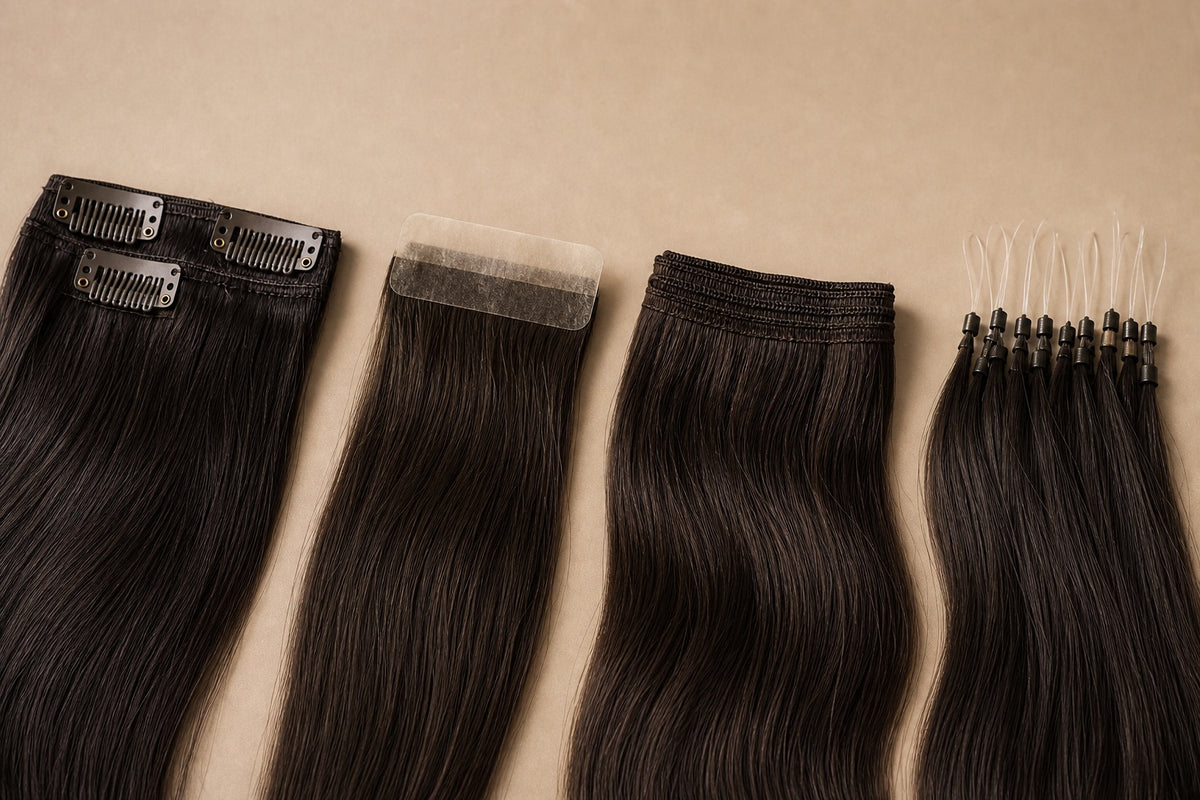
What it is. Clip-in sets are wefts of hair with small pressure clips sewn along the top. You snap them into your own hair in sections, wear them for the day, and take them out at night. No chemicals, no glue, no appointment.
Commitment level. The lowest there is — in and out in minutes, whenever you like. You're never locked in.
Who it suits. Anyone who wants the option of more hair without changing their daily life — volume for an event, length for a photo, fullness on a thin day. They suit fine and thick hair alike, because you control how much goes in and where. New to extensions and nervous? Start here: you learn how your hair takes to extra weight with nothing at stake.
Cost and upkeep. You buy the set once — no install fee, no salon cadence. With good hair they last a year or more of regular wear. Wash them only when product builds up, not daily.
Honest care notes. Because you take them out each night, clip-ins are the gentlest method on your own hair — there's no long-term pull. The one thing to watch is clipping the same few spots every single day; vary your placement so one section isn't always bearing the weight. This is the method with the least that can go wrong.
Try the hair first: a $10 sample shows you the color and movement in your hand before you commit to a full set.
Tape-ins — lightweight, semi-permanent, the popular middle ground
What it is. Tape-ins are thin wefts with a strip of adhesive along the top. A stylist sandwiches a section of your own hair between two taped wefts, so it sits flat and close to the scalp. They stay in day and night.
Commitment level. Medium. They live in your hair for roughly six to eight weeks, then a stylist removes them, and the same hair gets re-taped and reapplied as your roots grow out.
Who it suits. The crowd favorite for a reason — fast to apply, flat, light. It's especially friendly to finer hair, because the wefts are thin and the weight spreads out instead of hanging from one track. If you want wake-up-ready hair for weeks at a time without the bulk or salon hours of a sew-in, tape-ins are usually the sweet spot.
Cost and upkeep. You're paying for the hair plus a professional install, then a re-tape every six to eight weeks. Budget for that recurring visit — it's the real cost of tape-ins over a year, not the hair alone. Good hair can be reused across several re-tapes, which softens the math.
Honest care notes. Tape-ins are comfortable and low-drama if the removal is done properly — the adhesive is meant to release with a remover solution, never by pulling. Most of the trouble people blame on tape-ins comes from rushing that step or stretching the wear past the re-tape window. Oil-based products near the roots can loosen the tabs early, so keep conditioner and oils to the mid-lengths and ends.
Match before you book: a $10 sample confirms the shade against your roots so the install blends from day one.
Sew-ins — sturdy, long-wear, the most coverage
What it is. A sew-in uses full wefts (sometimes searched as "bundles" — same thing) stitched onto your own hair after it's been braided down close to the scalp. It's the most established method in the trade and adds the most hair at once.
Commitment level. High. Once it's in, it's in for several weeks of continuous wear — you sleep, shower, and live in it until your next appointment.
Who it suits. Thicker, stronger hair that can carry braids and the weight of multiple wefts. If you want a dramatic change in length or density, or full coverage in one go, the sew-in delivers more than any other method. Paired with a closure or frontal, it gives a complete, natural-looking part. It suits people who'd rather visit the salon a few times a year than fuss daily.
Cost and upkeep. Higher install cost because it's labor-intensive, but a longer stretch between appointments — often six to ten weeks. The per-visit cost is the highest of the four, though the visits are few.
Honest care notes. The whole comfort of a sew-in lives in the tension — braids and stitches firm enough to hold but never so tight they pull at your hairline. If a fresh install feels tight or sore, raise it with your stylist rather than toughing it out. Keeping the braided scalp underneath clean and dry matters too, since it's covered for weeks. This is the method where who installs it makes the biggest difference, so leave it to experienced hands.
Feel the weight and texture first with a $10 sample before you order a full set of wefts.
Micro-links — no heat, no glue, repositionable
What it is. Micro-links — also called beads, i-tips, or micro-rings — attach small sections of hair using tiny silicone-lined metal rings, clamped closed around your own hair and the extension strand. No heat, no adhesive, no sewing.
Commitment level. Medium to high. They stay in for weeks and, as your hair grows, a stylist opens the beads, slides them up, and re-clamps — the same hair moved up rather than fully reinstalled.
Who it suits. People who want long, natural movement and prefer to avoid glue and heat entirely. Because each section is small and independent, the result moves like your own hair. The honest caveat: the beads need something to grip, so micro-links suit medium to thicker hair better than very fine hair, where small beads are harder to hide and the hold is more delicate. If you specifically want a no-chemical method, this is it.
Cost and upkeep. A precise, time-consuming install, then a "move-up" appointment every couple of months to follow your growth. Plan for that cadence — it's central to how micro-links stay comfortable and undetectable.
Honest care notes. With even, gentle pressure, micro-links are kind to the hair — no heat or glue. The two things to mind are even tension at install (a job for an experienced hand) and keeping the move-up schedule — left too long, grown-out beads slide down and tug. Skip conditioner directly on the beads so they don't slip.
Check the texture match with a $10 sample so each section blends with your own.
The decision, in one table
Read down the column that sounds most like you. Where your answers cluster is your method.
| If you want… | …and you'll install… | …on a budget that's… | Best fit |
|---|---|---|---|
| It in and out the same day | Yourself, at home | One-time, no upkeep | Clip-ins |
| Weeks of wake-up-ready hair, lightweight | A salon | Moderate, recurring every 6–8 wks | Tape-ins |
| Maximum coverage / dramatic change | A salon | Higher per visit, fewer visits | Sew-ins |
| Natural movement, no heat or glue | A salon | Moderate–high, move-up every ~2 mo | Micro-links |
A few honest tiebreakers:
- Fine hair? Lean clip-in or tape-in — both spread weight gently. Be cautious with heavy sew-ins and very small micro-links.
- First time and unsure? Clip-ins, every time. Lowest cost, lowest risk.
- Want it handled while you live your life? Tape-in for comfort and wear; sew-in for the most hair and the fewest appointments.
- Avoiding heat and glue on principle? Micro-links.
And the one that underpins all four: the method only matters if the hair is good. A clean install of poor hair still sheds, tangles, and dulls after a few washes — and then people blame the method, not the hair. Genuine cuticle-intact, single-donor hair behaves the way real hair on a real head does: it lasts, it blends, it ages gracefully. That's the half of the decision the comparisons leave out.
Want to go deeper on the hair itself? Start with Hair Extensions 101. Curious how much you'll need for the look you're picturing? How much hair do I need does the math. And for the installer's view of these methods, the techniques guide walks through how each one is done.
The smartest first move is always the cheapest one: get the hair in your hand before you commit to a method. Order a $10 shade-and-texture sample →, then choose with confidence — clip-ins, tape-ins, sew-in wefts, or micro-links.
Written from the Prarvi workbench by Preeti Gupta — chemical engineer and founder, with about a decade sourcing single-donor Indian hair. There's no best method, only the one that fits your hair and your life — and we'd rather help you find it than sell you the wrong one beautifully.
