
In this article
When a cosmetic chemist orders hair tresses for testing, the request often starts with a simple phrase: "We need human hair tresses."
That is a start, but it is not a full specification.
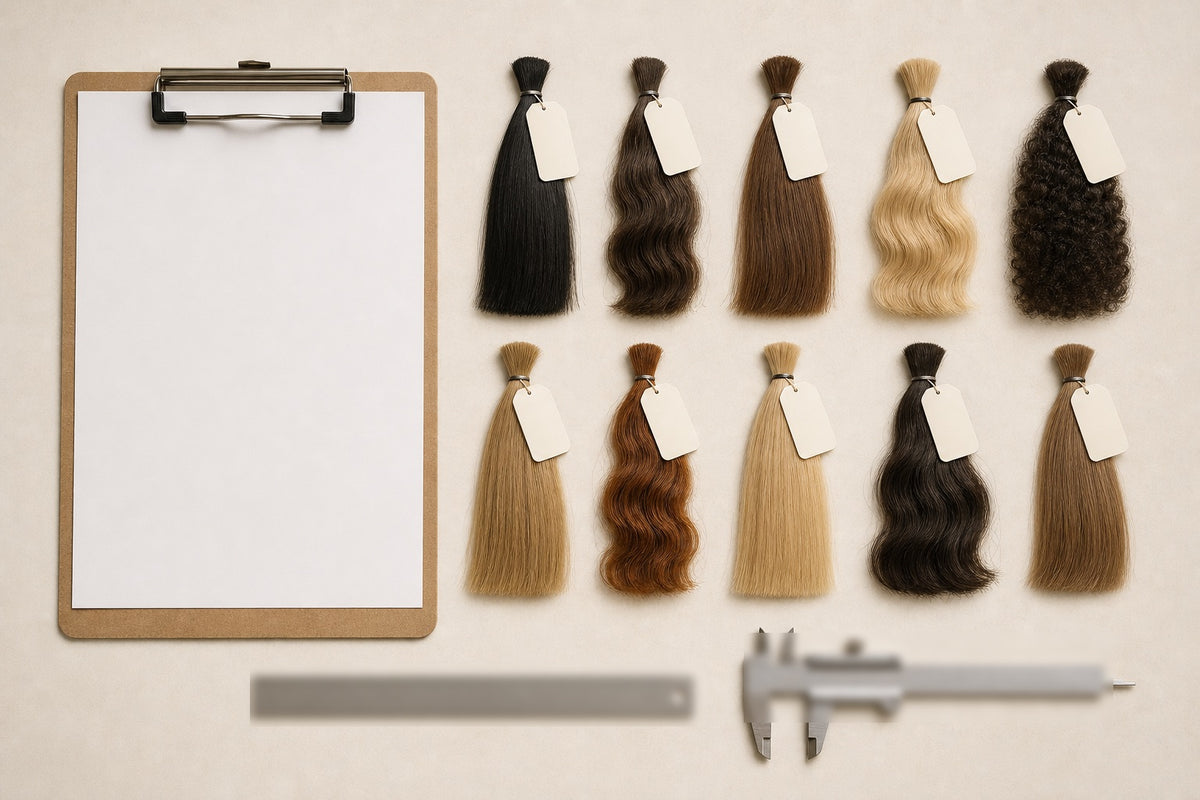
For hair-care product evaluation, the tress should be specified with the same seriousness as the method. The formula, application amount, rinse conditions, drying method, combing method, and measurement technique all matter. So does the hair.
This checklist is written from my practical experience as a chemical engineer in the human hair business, working with salons, samples, research buyers, and product-development inquiries.
1. Test objective
Start with the question the test is trying to answer.
Examples:
- Dye uptake or tone.
- Grey coverage.
- Conditioning and slip.
- Wet or dry combability.
- Frizz reduction.
- Shine.
- Breakage or repair.
- Heat protection.
- Curl definition.
The test objective should guide the substrate.
2. Baseline color
Specify the starting color:
- Natural black.
- Dark brown.
- Blonde or lightened.
- Grey.
- Salt-and-pepper.
- Treated white.
- Custom color.
Color baseline is especially important for dye, toner, fade, grey-coverage, and visual-evaluation work.
3. Processing history
Ask whether the hair is minimally processed, bleached, dyed, coated, steam-textured, relaxed, permed, acid-treated, or otherwise modified.
If processing history is unknown, note that uncertainty in the study design.
4. Damage state
If damaged hair is needed, define the damage:
- Bleach damage.
- Heat damage.
- Mechanical combing damage.
- Chemical relaxer or perm damage.
- UV or environmental stress.
- Repeated wash stress.
"Damaged" by itself is too broad.
5. Texture
Specify straight, wavy, curly, coily, relaxed, or custom texture. For curl and frizz testing, texture is central to the study.
If possible, define the curl pattern or at least the intended consumer hair type.
6. Cuticle orientation
Ask whether the hair is aligned, mixed-direction, or unknown. Cuticle direction can affect tangling, friction, combability, shine, and surface feel.
7. Donor mixing
Decide whether the study needs:
- Single-donor hair.
- Limited-donor hair.
- Mixed-donor hair.
- A consumer-representative mixed panel.
Controlled donor lots may reduce noise. Mixed lots may better represent broader consumer variation.
8. Coating and pre-wash
Ask whether the hair has a coating or finishing treatment. Decide whether the tress should be pre-washed before testing and document the wash method.
This matters for shine, slip, combing, and conditioning evaluation.
9. Length, weight, and form
Specify:
- Length.
- Grams per tress.
- Number of tresses.
- Bonded tip, flat tip, weft, or loose bulk hair.
- Mounting or fixture needs.
Product dose should be calculated relative to hair weight and method.
10. Lot and repeatability
If the study will continue over time, request lot information and discuss whether a batch hold is needed. Changing lots mid-study can create unwanted variation.
The takeaway
The hair tress is part of the experimental design. A better specification helps chemists choose a substrate that matches the product claim, the consumer use case, and the measurement method.
For teams that need human hair tresses for formulation, color, repair, combability, frizz, or product-efficacy testing, Prarvi can help review the specification before quoting: request a research quote.
Continue the series
- Hair Tresses as Test Substrates: What Cosmetic Chemists Should Control Before Testing
- Raw, Bleached, Processed or Damaged Hair Tresses: Choosing the Right Test Substrate
- Porosity, Cuticle Alignment and Donor Mixing: Hidden Variables in Hair-Care Testing
- Grey, Blonde, Curly and Coily Hair Tresses: Why Color and Texture Change Test Results
