
In this article
Here's something almost no hair-care routine accounts for: your hair is two completely different things at the same time.
At the root, it's alive — a biological system, fed by blood, driven by hormones and genetics. A few millimeters higher, the exact same hair is dead — a finished material, held together by chemistry alone. Most people care for one half and ignore the other, then wonder why their hair looks healthy at the roots and fried at the ends.
Great hair care isn't one job. It's two. Let's separate them — because once you see the split, everything about caring for your hair (and your extensions) makes sense.
Half one: the biology — the living hair
Everything happening inside your scalp is biology.
Each hair grows from a follicle, a tiny living organ. At its base, cells divide rapidly, fed by a blood supply, and follow a growth cycle that runs for years. This living machinery decides how fast your hair grows, how thick it is, its natural curl pattern, and its color.
Caring for the biology means caring for the living system:
- Scalp health first. The follicle lives in your scalp — a clean, balanced, well-circulated scalp is the soil your hair grows from. Buildup, inflammation, and neglect start here.
- Gentle tension. Follicles are living, and they can be damaged. Constant tight pulling (aggressive ponytails, badly installed extensions) can inflame or even permanently stress them — real damage called traction alopecia.
- Nutrition and circulation. Hair is grown from the inside out. What supports your body supports the follicle.
The critical point: only the hair still attached to your head has this living half. The moment a strand leaves your scalp, its biology is over. It cannot heal, repair, or regrow itself — ever again.
Half two: the chemistry — the finished strand
Everything you can see, touch, brush, and style is chemistry.
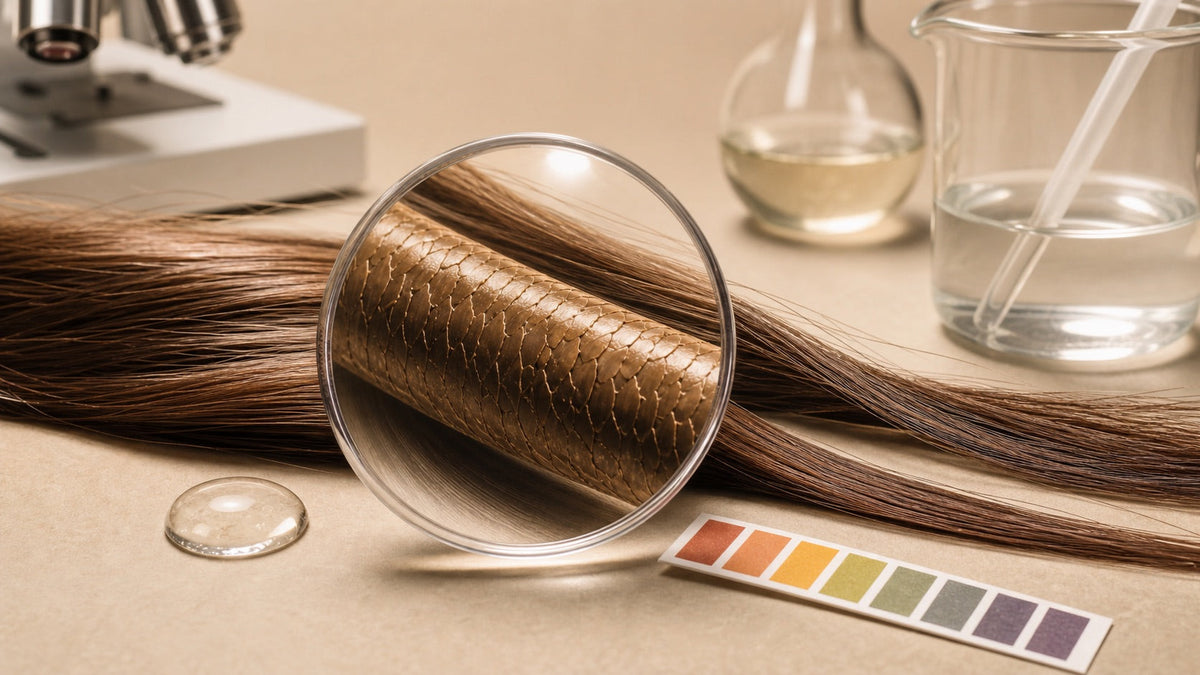
The strand is roughly 90% keratin — a protein — wrapped in a protective outer layer of scales called the cuticle, around an inner cortex that holds its strength and color. Its shape is locked in by three kinds of bonds:
- Disulfide bonds — the strongest, permanent ones. They set whether hair is straight or curly. Only harsh chemistry (bleach, perms, relaxers) breaks them — and once broken, they're permanently changed.
- Hydrogen bonds — weak and temporary. Water breaks them; that's why hair reshapes when wet and holds a blow-out until humidity hits.
- Color comes from melanin locked in the cortex. Bleach destroys it — that's chemistry, not 'lightening.'
Caring for the chemistry means protecting a finished material:
- Guard the cuticle. Aligned, closed cuticle scales mean shine, smoothness, and strength. Rough handling, harsh sulfates, and heat lift and chip them away. (For the deep science, see porosity, cuticle alignment and why they change how hair behaves.)
- Protect the bonds. Heat and bleach damage disulfide bonds permanently — there's no living follicle behind the strand to rebuild them.
- Manage moisture. A dead strand can't hydrate itself. Conditioning and sealing keep keratin flexible instead of brittle.
The twist that changes everything: dead to biology, alive to chemistry
Once hair exits the scalp, it's biologically dead but chemically alive. It can't heal — but it can still be changed, damaged, colored, and conditioned for the rest of its life.
That single fact is why 'repairing' damaged ends is a myth. You can't repair a dead strand — you can only maintain it (chemistry) or cut it off and grow a new one (biology). Both are true at once, on the same head of hair.
Why extensions make this a two-front job
Here's where it gets practical. The moment you wear extensions, you're caring for two different kinds of hair at the same time.
| Your natural hair | Your extensions | |
|---|---|---|
| Biology (living) | Yes — scalp, follicles, growth | None — no follicle, no life |
| Chemistry (the strand) | Yes | Yes — this is all it is |
| Can it heal itself? | The roots grow anew | Never — maintenance only |
| What it needs | Scalp care, gentle tension, nutrition | Cuticle protection, moisture, low heat, no harsh chemistry |
Extensions are pure chemistry, zero biology. There's no follicle feeding them, so every day they're worn is a day of slow chemical wear that only you can slow down. Meanwhile, the living hair underneath still needs its biological care — a healthy scalp and no punishing tension. Our complete guide to caring for hair extensions walks through the day-to-day.
Your two-part care routine
| Care the biology (living hair + scalp) | Care the chemistry (the strand + extensions) |
|---|---|
| Keep the scalp clean and balanced | Use gentle, sulfate-smart cleansing |
| Avoid constant tight tension | Condition and seal to hold moisture |
| Support circulation | Minimize high heat; always heat-protect |
| Nourish from the inside | Avoid unnecessary bleach and harsh processing |
| Let follicles rest between tight styles | Detangle gently, ends first, to protect the cuticle |
Why the starting chemistry decides the ceiling
You can only maintain the chemistry your hair already has — you can't add quality back. This is exactly why the hair you start with matters.
Raw, single-donor hair arrives with its cuticle intact and aligned, all flowing the same direction, its natural chemistry unaltered — a strand built to be maintained for years. Heavily processed hair has had that chemistry stripped in acid baths and masked with a silicone coating, so once the coating washes off there's no real cuticle left to protect. (Confused by the labels? Read raw vs. virgin vs. remy, explained, then how to care for raw Indian hair.)
Biology gave that hair its structure. Chemistry is what you're preserving. Great care simply respects both.
Want extensions whose chemistry is actually worth maintaining? Prarvi's raw, single-donor Indian hair keeps its cuticle intact — so the care you put in is care that lasts. Request a sample and talk to us about a match for your texture and shade.
