
In this article
You found hair you love online. You ordered it. It arrived — and it looks nothing like the photo on your own head. So you open YouTube, fall down a two-hour rabbit hole of conflicting advice, and close the tab more confused than when you started.
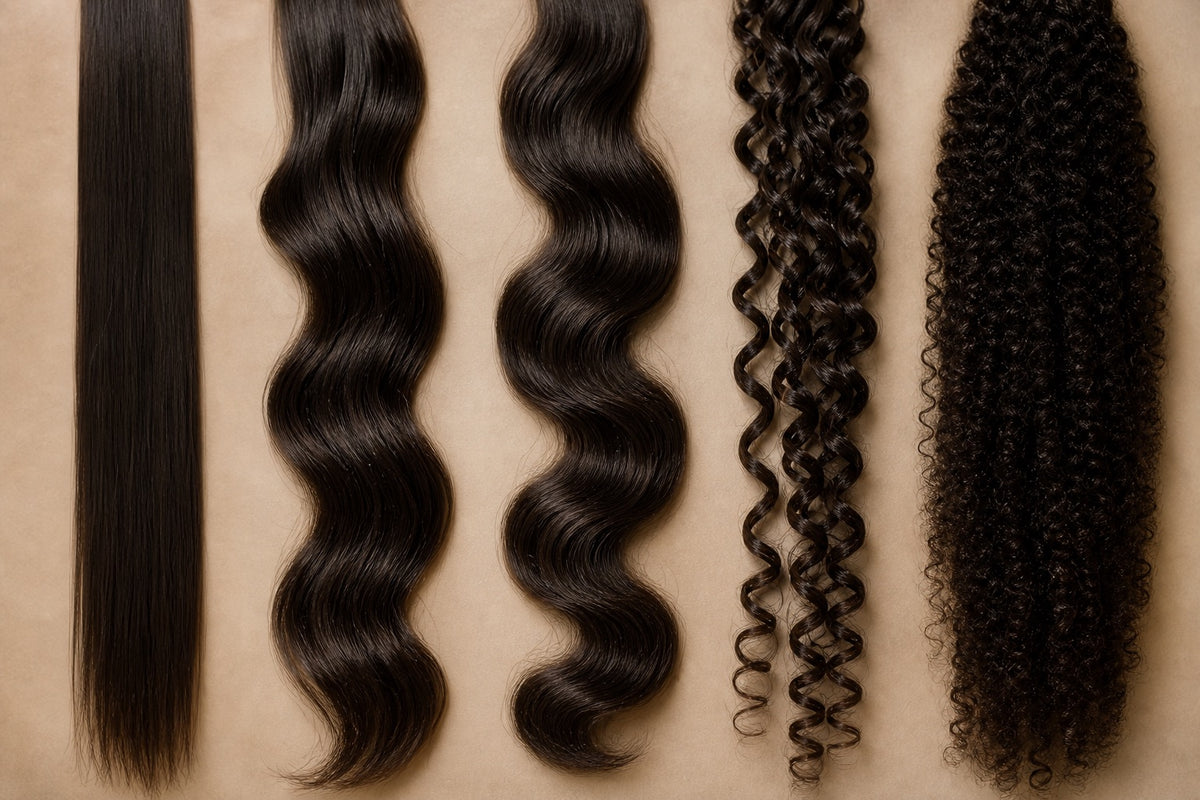
That's the most common dead-end in buying extensions, and it almost always comes down to one thing: texture. Natural wave, body wave, kinky curl, straight — the words sound interchangeable, the thumbnails look similar, and nobody explains how to tell them apart or which one is actually yours. So let's fix that. By the end of this you'll be able to name the texture you need, match it to your own hair, and confirm it in your hand before you commit to a full order.
First, the honest part: only three textures grow that way
Here's the thing the industry rarely says out loud, and it changes how you should read every texture name. Only three textures occur naturally on a human head:
- Straight — grows straight.
- Natural wave — grows with a soft, irregular S-bend.
- Natural curl — grows in a genuine spiral.
Every other "texture" you'll see — body wave, loose curl, kinky curl, coily — is steam-set. That means it's real, single-donor human hair that has been steam-permed into a pattern. It is not synthetic, and it is not a downgrade. In fact, it's a tell that you're holding genuine hair: a steam-set pattern gently relaxes toward its natural state after a few washes, and you re-set it with heat or steam, exactly the way your own hair behaves. A fiber with a printed-on wave never relaxes — it can't, because there's no real cuticle there to respond.
So when you choose a textured set, plan for that softening. The first-day pattern is the tightest you'll ever see it; it settles into something a touch looser and, honestly, more natural-looking after it's lived with you for a week. That's the hair working correctly, not failing.
Keep that in your back pocket as we walk through each one.
Straight
What it looks like: Sleek, flat, no movement — the cleanest, most uniform finish. Light bounces straight off it, so it reads as glossy and polished.
Whose hair it suits: Anyone with naturally straight or very lightly waved hair, and anyone who heat-styles to straight as their default. If your hair dries pin- straight on its own, this is your seamless blend.
How it wears: The most predictable texture there is. It stays where you put it, shows length honestly (no take-up — what you measure is what you wear), and is the easiest to blow out. The trade-off is that straight hair shows a poor color match or a thin install more than any other texture — there's no pattern to hide behind — so shade-matching matters most here.
Natural wave
What it looks like: A soft, undone S-bend that runs the length of the strand — relaxed, beachy, never tight. This is one of the naturally occurring textures, so the wave is irregular and organic rather than uniform.
Whose hair it suits: The most universally flattering texture, and the one we point most first-time buyers toward. If your own hair has any natural bend — air- dries with a slight wave, holds a loose curl, won't sit perfectly flat — natural wave blends almost invisibly. It's also forgiving if your texture sits between straight and curly, which most people's does.
How it wears: Easygoing. Because the wave is natural rather than steam-set, it doesn't relax out the way the set textures do — it stays roughly the same wave through washes. It hides a slight color variation better than straight, and it gives movement without daily styling.
Body wave
What it looks like: A larger, glamorous, blown-out wave — think the loose, rolling "salon blowout" pattern. More structured and uniform than natural wave, with a deliberate bend.
Whose hair it suits: Anyone who loves the polished-blowout look but doesn't want to curl their hair every morning. It's a styled texture, so it suits a styled finish — great for occasion wear and for people who already heat-style.
How it wears: This is a steam-set texture, so remember the honest note: the wave is at its most defined on day one and relaxes looser after a few washes. That's normal. You refresh it with a curling wand or rollers when you want the full blowout back. If you want a wave that looks worked-on, body wave delivers it without the daily labor — just plan to re-set it occasionally.
Loose curl
What it looks like: A defined, springy curl that's still soft and open — bigger than a tight ringlet, with real bounce and dimension.
Whose hair it suits: Anyone with naturally curly hair on the looser end, or anyone who wants curl as their everyday texture without it reading as tight. It sits in the sweet spot between body wave and kinky curl.
How it wears: Also steam-set. Like body wave, the curl is tightest when it arrives and softens with washing, then re-sets with a wand or flexi-rods. Because the pattern is more defined than a wave, it carries the most dimension — and it's the most forgiving of all on color match, since the curl breaks up the light.
Kinky curl
What it looks like: A tight, voluminous curl with a lot of body — full, textured, and the closest match to naturally curly and afro-textured hair. This is the most dramatic, highest-density-looking texture we offer.
Whose hair it suits: Anyone with naturally kinky, curly, or coily hair who wants a blend that disappears into their own pattern — which straight or wavy extensions simply can't do. If you've struggled to find extensions that match your curl, this is the one to sample.
How it wears: Steam-set, and the most important take-up case of all. The curl is gorgeous and full, and like all set textures it relaxes a little after washes and re-sets with heat or steam. The bigger thing to plan for is length — which is the take-up note, next.
The one rule that trips everyone up: textured hair wears shorter
This is the single most common ordering mistake, so it's worth saying plainly.
All real hair — ours and everyone's — is measured pulled straight. That's the industry standard. But a wave, curl, or coil takes up length, so the hair falls shorter once it's in than the number on the tag. A wave wears a little shorter than the tag; a curl noticeably shorter; a tight kinky curl significantly shorter.
That take-up isn't a flaw — it's the proof you're holding genuine patterned human hair and not a flat fiber. The practical rule: if you want a specific finished length on a textured set, order longer than the number you have in mind — and the tighter the pattern, the more you size up. Straight needs no adjustment; kinky curl needs the most.
We go deep on this in How Much Hair Do You Actually Need? — worth a read before you pick a length on any textured order.
How to match your own texture (a 30-second decision aid)
You don't need to overthink this. Look at your hair the way it dries with no product and no heat, then read down:
- Dries pin-straight, no bend? → Straight.
- Air-dries with a soft, loose bend or beachy wave? → Natural wave.
- Want a polished, blown-out wave bigger than your natural one? → Body wave.
- Naturally curly on the looser, open end — or want everyday curl? → Loose curl.
- Naturally kinky, curly, or coily and want a true blend? → Kinky curl.
Two honest tie-breakers. First: match the texture you actually wear most days, not the one in your aspirational photo — extensions blend by following your hair, not fighting it. Second: if you sit between two textures (most people do), the looser of the two is almost always the safer pick, because it's far easier to add curl with a wand than to fight a too-tight pattern flatter every morning.
And if you're still building the whole picture — forms, install methods, where the hair comes from — start with Hair Extensions 101, then come back here for the texture call. Learning to install? Our techniques guide covers the how.
The only step that removes the guesswork: hold it in your hand
Here's the truth no product photo can fix: lighting lies, and your screen is not your bathroom mirror. Two textures that look nearly identical on a thumbnail feel completely different in your fingers — the wave depth, the curl spring, how the color reads against your skin, how it blends with your hair.
That's exactly why we sell $10 shade-and-texture samples. For the price of a coffee, you order the actual textures you're deciding between, hold them against your own hair in your own light, and know — before you spend on a full set. It's the cheapest way to skip the YouTube rabbit hole entirely and the single best thing you can do to avoid an expensive mismatch.
Pick the texture that matches the way your hair actually wears, size up if it's textured, and confirm it in your hand. That's the whole journey from confused to confident — and it costs ten dollars to be sure.
Order a $10 shade-and-texture sample → · or jump straight to your texture: natural wave · body wave · loose curl · kinky curl · straight.
Written from the Prarvi workbench by Preeti Gupta — chemical engineer and founder, with about a decade sourcing single-donor Indian hair. We'd rather you match the right texture once than re-order the wrong one twice.
