
In this article
Grey is the one shade the extension industry can't fake well — and almost everyone tries.
Walk the market and you'll find plenty of "grey" and "salt-and-pepper" hair. Look closely and most of it is hair that was lifted to blonde and then toned grey, or dark hair partially bleached to fake a mix. It reads convincingly in a product photo. Then it goes on a real head, in real light, next to real silvering hair — and the match drifts. The tones flatten, the silver picks up a yellow or violet cast as the toner fades, and the hair wears differently than your own because it has been through a chemical process yours hasn't.
There's a better way to match grey, and it starts with using the same thing nature used: hair that grew in grey.
Why genuine grey donor hair matches — and ages — better
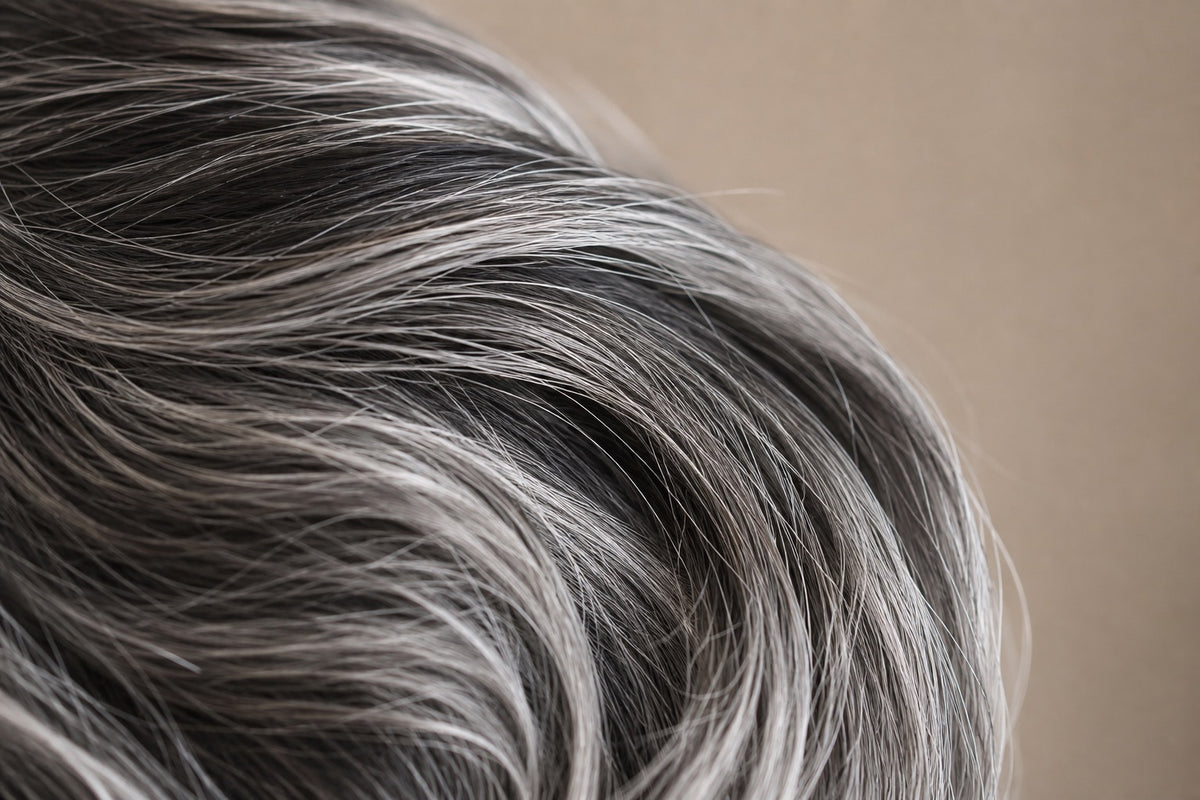
When you lose pigment, you don't turn one flat "grey." You get a mix: some strands that have gone fully white or silver (the "salt"), some that still hold their original dark pigment (the "pepper"), and a lot in between. That mix is what reads as natural salt-and-pepper. It's dimensional, slightly irregular, and specific to you.
Genuine grey donor hair is hair that did the exact same thing on someone else's head. It depigmented naturally, strand by strand, so it arrives already carrying that salt-and-pepper dimension — true white and silver strands among retained-pigment darks. That's a true virgin color: grown, not lifted. We don't bleach hair to make it grey and we don't tone it. There's nothing to fade.
This matters for two reasons, and they're worth separating.
It matches your tone honestly. Naturally silvered hair has a particular quality of reflectiveness and a neutral-to-cool cast that bleached hair struggles to copy. Bleached "grey" is built on a yellow base that toner sits on top of; as the toner washes out, the yellow returns and the match drifts warm. Genuine grey has no toner to lose.
It ages alongside you. Your own grey is still arriving — most people gain silver gradually for years. Genuine grey extensions don't shift over their life the way toned hair does, so the relationship between your hair and the hair you added stays stable instead of slowly diverging.
One honest caveat, because it's the whole reason this post exists: genuine natural-grey donor hair is rare. Most donors are younger; naturally grey ponytails are a small fraction of what's collected, and you can't manufacture more by bleaching. That scarcity is exactly why so much of the market sells the bleached imitation. It's also why matching grey rewards a little patience and a sample more than any other shade does.
Read your own ratio first: light pepper to heavy salt
Before you can match grey, you have to read it — and "grey" is far too blunt a word for what's actually on your head. The useful question is your ratio: how much salt (white and silver) versus how much pepper (retained dark pigment).
A simple way to read yourself, in good daylight, near a mirror:
- Light pepper / low salt. Mostly your original dark color with the first scattering of silver — often at the temples and part line. Maybe 10–25% silver overall. This is early salt-and-pepper.
- Balanced salt-and-pepper. A genuine mix, roughly half and half, dark and silver woven through each other. This is the classic "salt-and-pepper" most people picture.
- Heavy salt / low pepper. Predominantly silver and white with darker strands surviving here and there — say 70%+ silver. Heading toward fully grey or white.
Two more things to notice while you look, because they change the match as much as the ratio does:
- Distribution. Is your silver even all over, or concentrated — a silver streak, a grey temple, a lighter front and darker back? Even mixes are easier to match with one blend; concentrated grey may want a slightly different blend placed where your silver actually is.
- The pepper's tone. Underneath the silver, is your base near-black, dark brown, or softer brown? The dark half of salt-and-pepper has to match too, not just the silver half.
Hold a small section flat and look at it the way you'd read a fabric: count the lights against the darks. That count — your ratio — is the single most useful number to bring to a match.
Picking the closest blend
Once you know your ratio, choosing gets straightforward: match the blend to where you actually sit, not to where you'd like to be.
- If you read light pepper, you want a blend that's mostly dark with silver woven through — the silver should accent, not take over.
- If you read balanced, you want a true mixed salt-and-pepper.
- If you read heavy salt, you want a predominantly silver-and-white blend with just enough dark left to keep it from going flat.
A few principles that keep the result believable:
Match the ratio, then check the base. A blend can have the right amount of silver and still miss if its dark strands are browner or blacker than yours. Read both halves.
Aim for slightly more dimension, not less. Just like any natural shade, a hint of variation reads as more real, not less. A blend that's a touch more mixed than mathematically perfect usually looks better installed than a too-uniform one, because real grey heads are never uniform.
Don't over-correct toward "all grey." People newer to their silver often reach for more grey than they have, and the extensions end up lighter than their own hair. Match what's on your head today; you can always add more silver to a later order as your own catches up.
If you want a second read on any of this, our color-match help walks through reading your ratio with you — grey is exactly the case where a quick check saves a return.
Placement and blending for a natural result
Genuine grey gives you a real head start, but installation is where a good match becomes invisible — or doesn't.
- Put the silver where your silver is. If your grey concentrates at the temples, front, or part, weight the lighter blend there and keep darker hair lower and toward the back. Mirroring your own distribution is what sells it.
- Alternate and feather, don't stack. When you install more than one weft, mix them across the head rather than building one block of extension hair on one side. Feathering the added hair into your own at the perimeter hides any seam between your ratio and the blend's.
- Leave a little of your own out at the hairline. A thin amount of your own hair over the front blends the transition far better than a hard edge of extension hair, especially with grey, where the eye is quick to catch a line.
- Expect the dark half to behave like real hair. The pepper strands are genuine pigmented human hair and carry the same gentle donor-to-donor variation any natural shade does. A faint difference between two grey wefts is a natural shade difference, not a defect — and across the head it reads as dimension.
For the mechanics of wefts, sets, and install methods underneath all of this, our Hair Extensions 101 guide covers the forms and how they attach.
Why a $10 sample isn't optional for grey
For most shades I'd call a sample strongly recommended. For grey, I'll be blunter: order the sample. Two reasons, and both are specific to grey.
Ratios vary a lot — yours and ours. Salt-and-pepper isn't one color; it's a spectrum from light pepper to heavy salt, and genuine grey donor hair naturally varies too. The only way to know a blend sits where your ratio sits is to hold it against your own hair, in your own light. No swatch description can do that for you.
Screens distort grey worse than anything else. Grey and silver are exactly the tones cameras and displays handle badly. White balance pushes silver warm or cool; phone screens add their own cast; compression flattens the salt-and-pepper mix into a single muddy grey. The hair you see on screen is the hair least likely to be the hair you receive — not because anyone's hiding anything, but because the medium can't carry these tones accurately. The physical strand is the only honest reference.
A $10 shade sample lets you read the real blend against your real ratio before you commit to a full set. For grey, that ten dollars is the difference between a match and a guess.
So: read your ratio in daylight — light pepper, balanced, or heavy salt. Pick the blend that mirrors where you actually sit, base tone included. Place the silver where your silver lives, feather it in, and leave a little of your own out at the front. And because grey is the one shade screens can't be trusted on, confirm it with a strand in your hand.
Order a $10 shade sample → to read the blend against your own hair, then browse our genuine grey & salt-and-pepper collection → — real natural-grey donor hair, never bleached to fake it.
Written from the Prarvi workbench by Preeti Gupta — chemical engineer and founder, with about a decade sourcing single-donor Indian hair. Genuine grey is one of the rarest things we source, and the one shade I most want you to sample before you buy — because it's the one a screen will lie to you about.
