
In this article
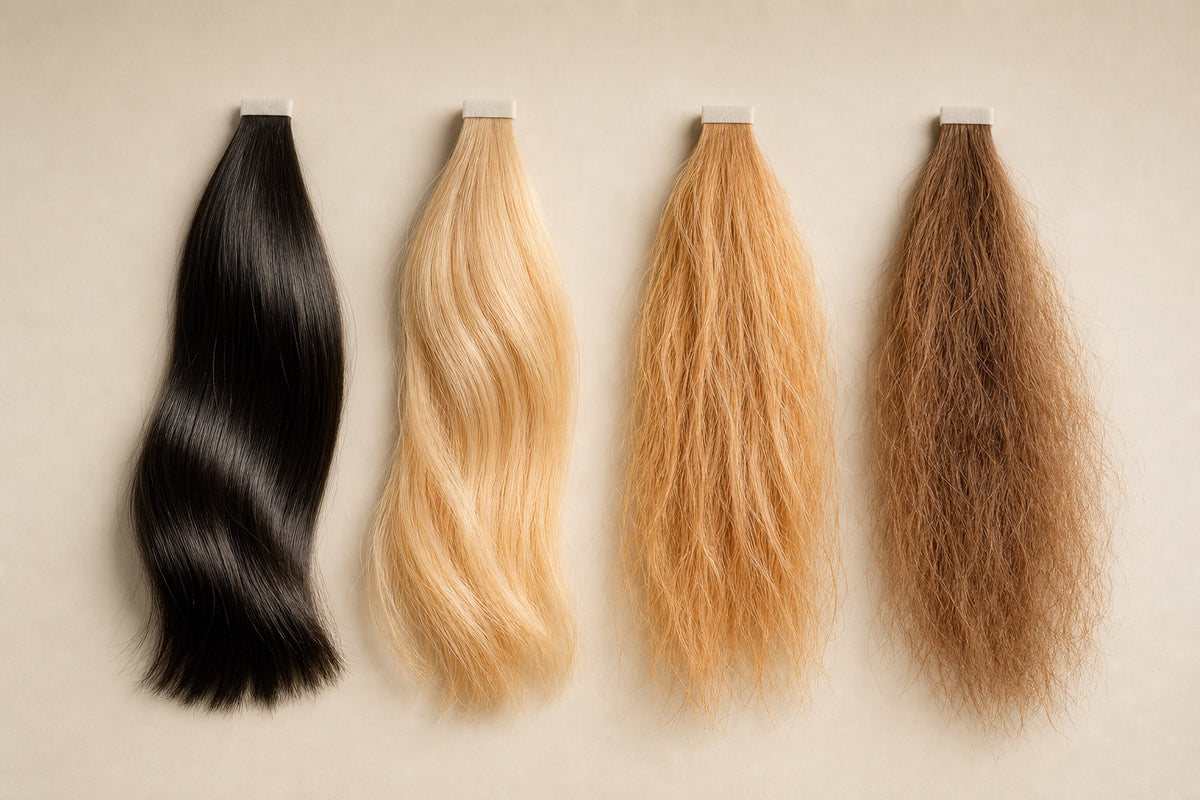
One of the most common mistakes in hair-care testing is using a tress label too broadly. A formulator may ask for "human hair tresses," "raw hair," "bleached hair," or "damaged hair" as if each phrase describes a single, standardized material.
In practice, those terms need more detail.
Raw, bleached, processed, and damaged hair are not interchangeable test substrates. Each can respond differently to surfactants, dyes, conditioning agents, polymers, oils, heat, humidity, combing, and mechanical stress.
Raw or minimally processed hair
Raw or minimally processed hair is useful when the goal is to evaluate product behavior on hair that has not been heavily altered. It may be a good substrate for baseline cleansing, conditioning, shine, softness, or natural-feel evaluations.
But "raw" still needs definition. Hair may differ by origin, donor mixing, color, texture, cuticle alignment, and cleaning process. A natural black straight tress and a natural curly tress may both be minimally processed, but they will not behave identically.
For chemists, raw hair is not a magic control. It is a starting point that still needs a specification.
Bleached and lightened hair
Bleached hair is a very different substrate. Lightening can increase porosity, alter tensile strength, change surface feel, and affect how materials deposit or rinse away. It may be the right choice for repair, tone, color-fade, porosity, and damaged-hair studies.
It can also exaggerate performance differences. A conditioner may show a strong improvement on bleached hair because the substrate is more damaged and more receptive to conditioning effects. That can be useful, but it should be understood.
If the real consumer target is blonde, lifted, highlighted, or color-treated hair, bleached tresses may be appropriate. If the target is natural dark hair, bleached tresses may not answer the right question.
Processed hair
Processed hair is a broad category. It can include dyed hair, acid-treated hair, steam-textured hair, chemically relaxed hair, permed hair, silicone-coated hair, or hair that has been permanently altered for color or texture.
Each process can change the fiber differently.
A coating may improve slip before the test formula is applied. Steam texturing may alter curl pattern and handling. Dye history can influence future color uptake. Relaxer or perm history can affect strength and elasticity.
This is why "processed hair" should not be accepted as a complete specification. The type of processing matters.
Damaged hair
Damaged hair is often requested for repair, strengthening, anti-breakage, or conditioning claims. But "damaged" is not one condition.
Damage can be caused by bleaching, heat, mechanical combing, UV exposure, chemical relaxing, repeated washing, or a combination of stresses. A lightly lifted tress is not the same as a heavily bleached tress. Heat-stressed hair is not the same as chemically relaxed hair.
For claim support, the damage model should match the claim.
If the claim is about bleach repair, bleach-damaged hair makes sense. If the claim is about heat protection, heat-stressed hair is more relevant. If the claim is about combing breakage, mechanical damage and combing protocol matter.
How to choose the right substrate
Start with the claim or test question:
- Color uptake: choose the right baseline color and porosity.
- Grey coverage: use grey or salt-and-pepper hair, not generic dark hair.
- Repair: define the damage type and severity.
- Conditioning: control coating status, porosity, and cuticle alignment.
- Curl/frizz: use the relevant texture.
- Repeat studies: control lot and donor mixing.
The right tress is the one that fits the experiment.
The takeaway
Raw, bleached, processed, and damaged hair tresses can all be useful. The problem begins when they are treated as interchangeable.
For cosmetic chemists, the practical step is to specify the substrate as carefully as the test method. A good tress specification can reduce noise, improve interpretation, and help make product-evaluation results more meaningful.
Prarvi supports research and product-development buyers with spec-matched hair tresses by quote: request a research quote.
Continue the series
- Hair Tresses as Test Substrates: What Cosmetic Chemists Should Control Before Testing
- Porosity, Cuticle Alignment and Donor Mixing: Hidden Variables in Hair-Care Testing
- Grey, Blonde, Curly and Coily Hair Tresses: Why Color and Texture Change Test Results
- A Hair Tress Specification Checklist for Cosmetic Formulators
