
In this article
This series is written from my viewpoint as a chemical engineer who has spent nearly 10 years sourcing, preparing, and selling human hair. My goal is simple: to bring more practical hair-industry insight to fellow chemists who use hair tresses for product evaluation.
When cosmetic chemists test a shampoo, conditioner, dye, bond-repair treatment, anti-frizz product, shine serum, or styling product, the test method is usually controlled carefully. The formulator decides how much product to apply, how long it stays on the hair, how the tress is rinsed, how it is dried, and how the result is measured.
But one variable is sometimes treated too casually: the hair tress itself.
Human hair is not a uniform laboratory material. It is a biological fiber with history. The way it was collected, sorted, processed, colored, coated, damaged, stored, and prepared can affect how it behaves in a test. If the tress is not specified carefully, the result may reflect the condition of the hair as much as the performance of the formula.
The scientific point is that the tress is not a neutral prop. It is the test substrate.
Why the substrate matters
A conditioner tested on minimally processed dark hair may not behave the same way on bleached hair. A dye tested on grey hair may not behave the same way on natural black hair. A combability test on straight aligned hair may not behave the same way on curly mixed-donor hair. A repair-claim test on lightly damaged hair may not behave the same way on heavily bleached or heat-stressed hair.
That does not mean one substrate is better than another. It means the substrate must match the question.
If the question is, "Does this conditioner improve slip on bleached hair?" then bleached hair is the correct substrate. If the question is, "How does this formula behave on natural dark hair?" then bleached hair may give the wrong answer. If the question is, "Does this curl product reduce frizz?" then testing only on straight tresses misses the point.
Variables chemists should ask about
Useful tress specification starts with practical questions:
- What is the baseline color?
- Is the hair minimally processed, lightened, dyed, coated, steam-textured, relaxed, or otherwise treated?
- Is the cuticle direction aligned or mixed?
- Is the tress single-donor, limited-donor, or mixed-donor?
- What is the texture: straight, wavy, curly, coily, relaxed, or custom?
- What is the damage state?
- What is the tress weight and length?
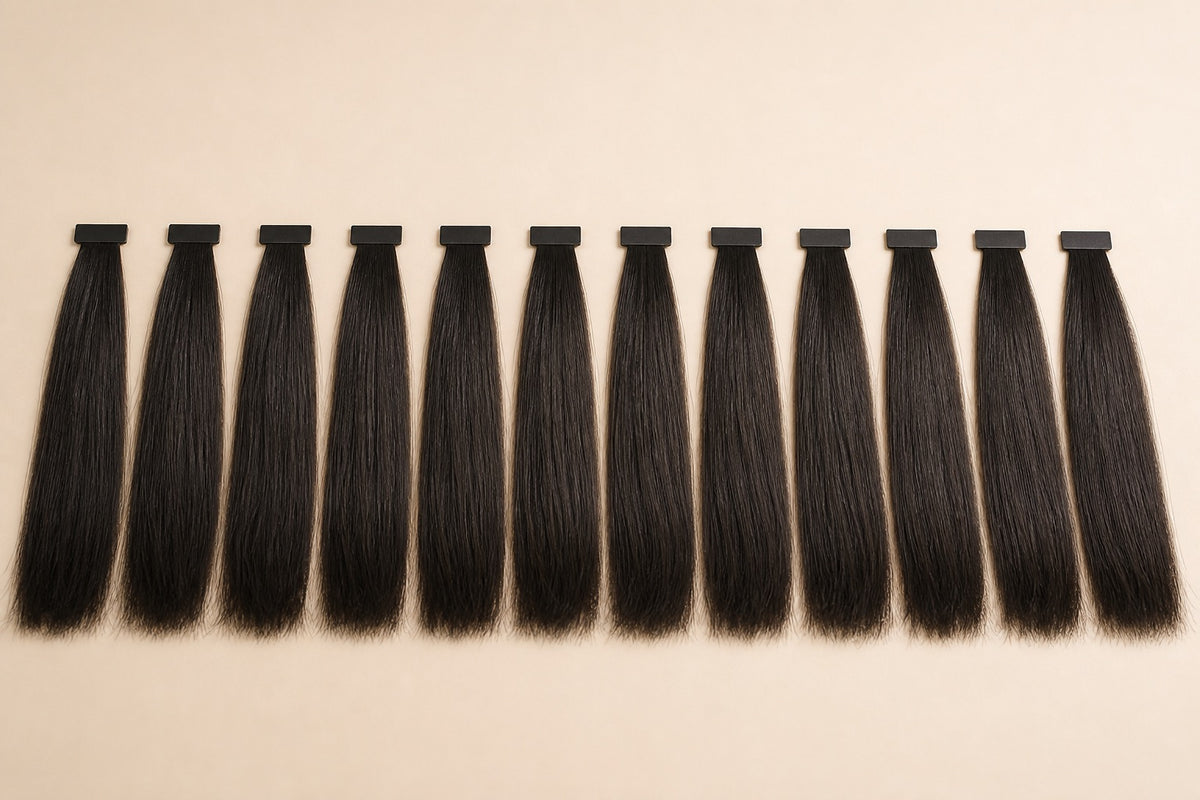
- Is it bonded, flat-tip, wefted, or loose bulk hair?
- Will future testing require the same lot?
Each answer can change interpretation.
What can go wrong
If a tress has a surface coating, the first combability or shine result may be influenced by the coating rather than the test formula. If a tress is more porous than expected, it may absorb dye or conditioning materials differently. If donor mixing is high, test-to-test variation may increase. If curl geometry varies across samples, frizz or breakage comparisons may become difficult.
These are not just supplier details. They are experimental-control details.
A practical way to think about it
Before ordering or preparing tresses, the formulator should define the testing question first. Then the hair substrate should be chosen to match that question.
For example:
- Dye uptake: control color baseline, porosity, processing history, and grey or blonde percentage.
- Conditioning: control damage state, cuticle alignment, coating status, and combing protocol.
- Breakage or repair: define the type and degree of damage.
- Frizz or curl: control texture, curl pattern, humidity exposure, and product distribution.
- Repeat testing: control lot, length, weight, and donor mixing.
The best tress is not always the most premium-looking tress. The best tress is the one that answers the test question.
The takeaway
Hair tresses are test substrates. Better substrate specification can improve reproducibility, reduce confusing results, and make hair-care product evaluation more defensible.
For cosmetic chemists, the better question is not only, "What product are we testing?" It is also, "What hair are we testing it on?"
If your team needs research-ready hair tresses, Prarvi can help review the practical specification before quoting: request a research quote.
Continue the series
- Raw, Bleached, Processed or Damaged Hair Tresses: Choosing the Right Test Substrate
- Porosity, Cuticle Alignment and Donor Mixing: Hidden Variables in Hair-Care Testing
- Grey, Blonde, Curly and Coily Hair Tresses: Why Color and Texture Change Test Results
- A Hair Tress Specification Checklist for Cosmetic Formulators
