
In this article
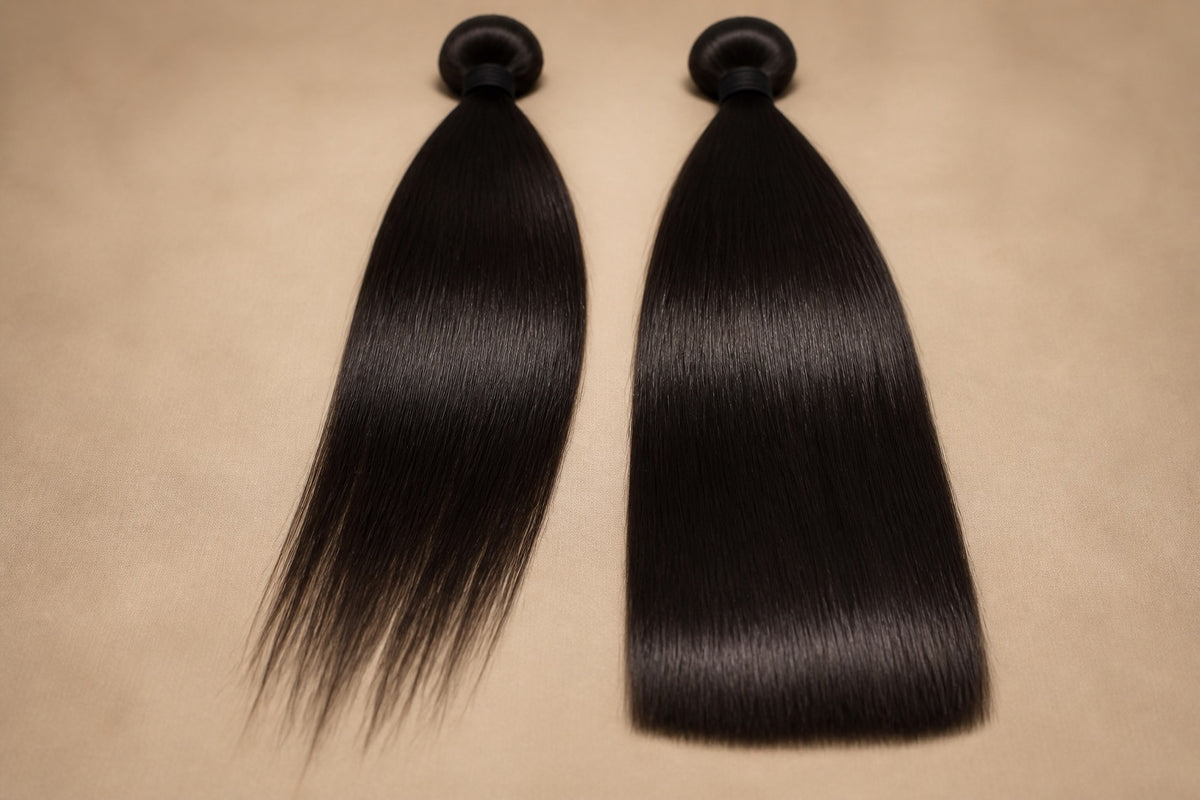
Single drawn and double drawn describe the distribution of strand lengths inside a bundle. Single drawn usually retains more of the natural variation in length; double drawn is sorted for a greater share of longer strands and therefore fuller-looking ends.
The terms do not identify a universal percentage, material, origin, donor count, processing history or quality grade. Compare the length distribution together with the hair-only mass and construction.
What does “drawn” mean?
Collected hair contains strands of different lengths. Drawing is the sorting work used to change that distribution. Retaining more shorter strands produces a more tapered bundle; removing more shorter strands or building the bundle with a greater share of long strands produces fuller ends. Drawing can be applied to single-donor or mixed-donor material, so donor composition must be disclosed separately.
Single drawn hair
Single drawn hair retains a broader mix of strand lengths. The bundle commonly looks fuller near the top and more tapered through the ends. No fixed “50% full length” rule applies across the market; a seller may publish its own measured specification, but the term alone does not supply that number.
- Visual effect: a softer taper that can suit layered finishes.
- Quantity question: fullness depends on the installed hair-only mass as well as the length distribution.
- Price: it may require less sorting than a fuller-ended comparison bundle, but price also reflects material, processing, construction and service.
Single drawn does not automatically mean lighter. Two bundles with the same stated hair-only mass should weigh the same; the difference is where that mass sits along the length.
Double drawn hair
Double drawn hair is sorted or assembled to contain a greater share of longer strands, so the ends look fuller. “Double” does not mean twice the weight, twice the hair or a standard 80% full-length specification.
- Visual effect: greater fullness through the lower lengths and ends.
- Style: often chosen for a denser or blunter silhouette.
- Labour: additional sorting can increase cost, but it does not establish the hair's processing history or fibre condition.
If a precise proportion matters, ask how the supplier measures it and whether the percentage applies by strand count or hair mass. Those are different measurements.
Single drawn vs. double drawn: quick comparison
| Question | Single drawn | Double drawn |
|---|---|---|
| Length distribution | Broader mix of lengths | Greater share of longer strands |
| Ends | More tapered | Fuller |
| Weight | Compare the stated hair-only mass; draw does not determine bundle weight. | |
| Universal percentage? | No. Ask for the seller's measured specification if a percentage matters. | |
Which should you choose?
Choose by the finished look, your existing density, the installation plan and the total amount of hair—not by the idea that one draw is universally better. A tapered distribution may suit layered styles. Fuller ends may suit a blunt or high-density finish. A stylist can help determine the appropriate installed mass and attachment method.
Draw is only one attribute. Also compare material, donor composition, processing history, cuticle direction, construction, hair-only mass and availability. Check the specific listing because every draw, texture and length combination may not be stocked.
Still deciding on length, texture, or shade before you commit to a draw? Order a hair sample first and match your shade and texture in your own light — it’s the easiest way to buy with confidence.
Frequently asked questions
Is double drawn hair always higher quality?
No. Double drawn describes length distribution. Material, processing, cuticle condition and construction must be evaluated separately.
Does single drawn hair shed more?
Not because it is single drawn. Shedding concerns fibre retention in the weft, bond or base, plus installation and handling. A tapered end is not the same thing as shedding.
Which is better for fine or thin hair?
The answer depends on the installed hair mass, attachment, distribution and the person's own hair—not the draw name alone. See our guide to extensions for thin hair and consult a qualified stylist.
Does double drawn mean 80% full length?
Not universally. A supplier may define and measure its own threshold. Ask how the percentage was calculated.
Can I get every draw in every texture and length?
Availability varies. Confirm the selected draw, texture, length, colour and construction before ordering.
Shop Natural Virgin Hair Order a Hair Sample
References & further reading
Compare the selected bundle, not only the draw name
Check the listing for hair-only mass, length, processing, texture, construction and availability. Ask for help planning the amount needed for your intended finish.
