
In this article
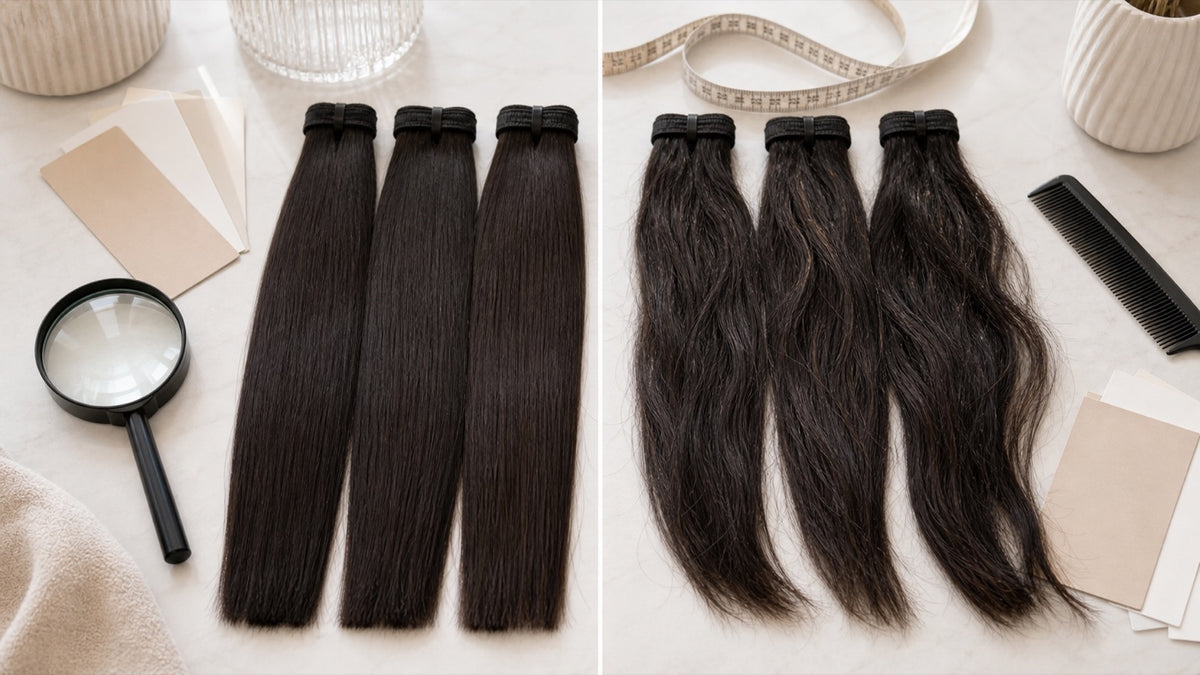
If you've ever compared two sets of “100% human hair” extensions and wondered why one looks blunt and equally thick from root to tip while the other tapers slightly toward the ends, you've run into one of the most misunderstood ideas in the extension world: single-drawn vs. double-drawn hair.
It sounds like a quality grade — as if “double” must beat “single.” It isn't. It's a description of how the hair was sorted after it was collected, and understanding it tells you something important about how raw, authentic, single-donor hair actually behaves.
What the terms actually mean
When hair is collected from a single donor, it comes in many different lengths at once — exactly the way it grows on a real head. Some strands are 22 inches, some are 14, some are 8.
- Single-drawn hair keeps that natural mix. The bundle is full and thick where most strands overlap, and tapers gently toward the longest tips — because fewer strands reach all the way to the end. This is hair in its honest, untouched state.
- Double-drawn hair has had the shorter strands manually removed so that almost every strand reaches the full length. The result is a bundle that's the same thickness top to bottom — uniform, blunt, dense at the ends.
That uniformity looks impressive in a photo. But ask the obvious question: where did the shorter strands go?
The catch nobody mentions
To make hair double-drawn, you have to do one of two things:
- Pull out and discard the shorter strands — which can mean removing 30–50% of the weight of the original bundle. Someone pays for that waste, and it's you.
- Blend in hair from other donors to fill the volume back up — which means it's no longer single-donor hair.
Here's the part that matters: “single-donor” and “double-drawn” are very hard to have at the same time. True raw, single-donor hair — one person's hair, never blended, never chemically processed — is naturally single-drawn. The gentle taper isn't a defect. It's the fingerprint of authenticity. It's proof the hair came from one head and wasn't cut down and re-sorted or mixed with someone else's.
When a brand advertises double-drawn single-donor hair at a value price, it's worth a second look. Uniform thickness almost always means the hair was either heavily processed, sorted with significant waste, or blended.
So is single-drawn “worse”? No — it's more real
At Prarvi, our extensions are raw, virgin, single-donor Indian Remy hair — cuticles intact and aligned in one direction, collected ethically, never acid-bathed or silicone-coated to fake shine. That means our wefts are single-drawn, and yes, they taper slightly at the longest tips.
We could double-draw them. We choose not to — because doing it honestly would mean either throwing away half of a donor's beautiful hair or blending donors together, and either way you'd be paying more for less authentic hair. We'd rather give you the real thing and show you how to style it for the fullness you want.
How to get fuller, blunter ends — without giving up raw hair
If you love a thick, blunt end (and many people do), you have three easy options:
- Buy a longer length and trim it. This is the stylist's secret. Order, say, a 22-inch weft and have it cut to 16 inches — the taper that lived in the last few inches is gone, and you're left with dense, blunt ends made of the same authentic single-donor hair. You control the exact look.
- Add a pack. Single-drawn hair is designed to be layered. Our guidance — 2 packs up to 18 inches, 3 or more above 18 inches — exists precisely so you get salon-level fullness all the way down.
- Ask us about a custom double-drawn order. If you specifically want a uniform double-drawn set, we can prepare one to order — clearly priced for the extra labor and the hair that's set aside in the process. We'll always tell you exactly what you're getting.
The bottom line
Double-drawn isn't a higher grade of hair — it's a finishing process, and it comes at a cost (in waste, in blending, or in your wallet). Single-drawn, single-donor raw hair is the most authentic form you can buy. The slight taper is a feature, not a flaw — and with a longer length or an extra pack, you get every bit of the fullness, with none of the compromise.
If you're not sure which length or how many packs you need for your look, talk to us or order a $10 sample first. We'd rather help you get it right than sell you hair that isn't truly yours.
Shopping for raw single-donor Indian hair?
Bundles, closures, frontals, wigs & toppers — raw, single-donor Indian hair, US-based and shipped fast from New Jersey. Not sure what to pick? We'll help you match texture and length.
