
In this article
If you’ve ever stared at a row of bundles and wondered why some lie flat as a second skin while others feel bulky against your scalp, the answer is almost always the weft. It’s the quiet engineering detail that decides whether your install reads “wait, is that your real hair?” or not.
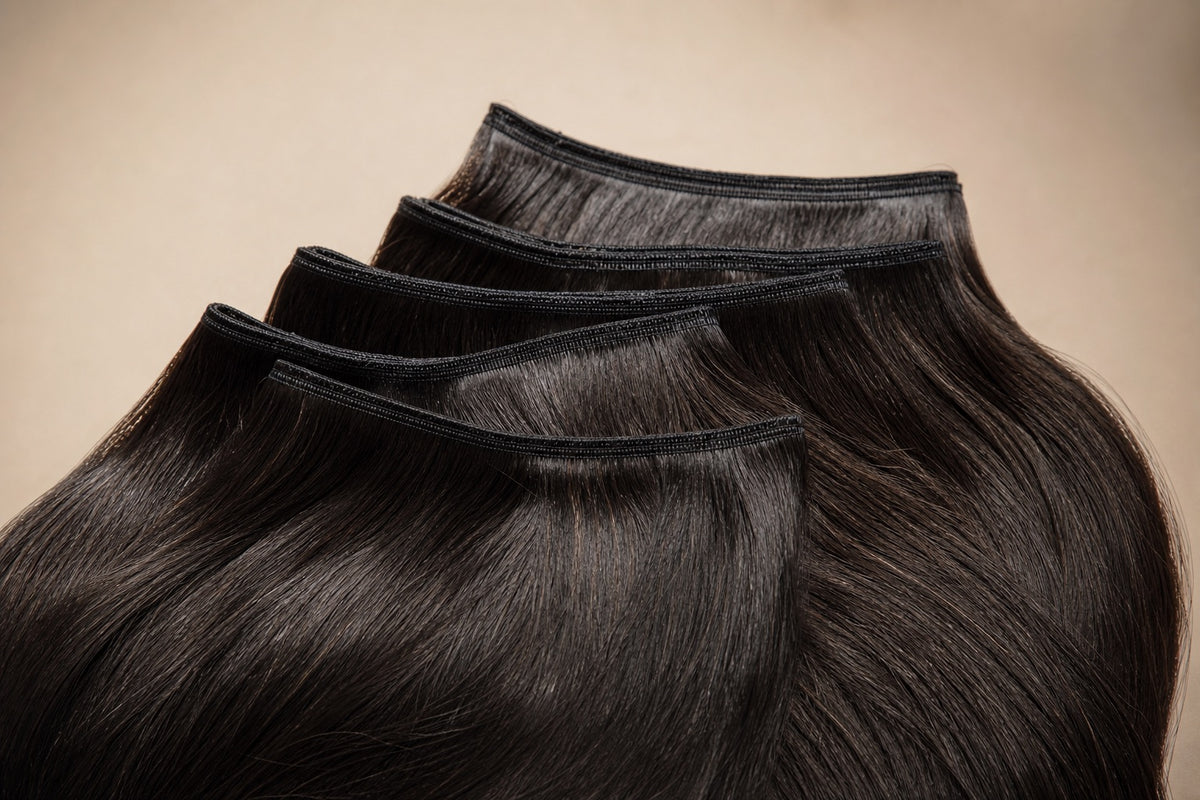
A weft is simply the seam that holds loose hair together into a usable strip. Bulk hair is fed through a sewing process that locks a reinforced stitch near the root, so the strands stay aligned and shed-resistant. With true Remy hair — the kind PRARVI uses — every cuticle runs in the same direction along that seam, which is exactly why a good weft lies smooth and stays tangle-free wash after wash.
But not all wefts are built the same way, and the type you choose changes how flat it sits, how long it lasts, and how it’s installed. Here’s the honest, editor-tested breakdown.
The three main weft types
Machine weft. The workhorse of the extension world. Hair is sewn on a specialized machine into a strong, sturdy strip, then folded and stitched a second time so nothing slips loose. Because the seam is sealed by that double stitch, you can cut a machine weft to length without it unraveling — a real advantage if you’re sectioning across the head. Machine wefts are typically installed by sew-in (braided foundation) or with a low-damage keratin bonding method that releases with oil or a gentle solvent. The trade-off: the seam is slightly thicker, so they suit medium to thick hair better than very fine hair that needs an invisible blend.
Hand-tied weft. Here, tiny sections of hair are tied by hand onto a fine thread, creating a much thinner, flatter seam. The payoff is a barely-there finish that sits close to the scalp and sheds less — ideal for finer hair or anyone chasing a truly undetectable result. The catch: hand-tied wefts can’t be cut (cutting opens the knots), so they’re made to a set length and installed by sewing in. They also tend to cost more, because the labor is exactly that — labor.
Skin (PU) weft. The newest style, where hair is bonded to a thin polyurethane backing that mimics the look of skin. It’s applied with a specialized adhesive and gives a seamless, tape-like finish. The honest drawback: skin wefts are the least durable of the three and need re-application far sooner, so think of them as a short-term or special-occasion option rather than a long-haul install. If you love the flat, skin-like feel, our tape-in extensions deliver a similar look with a more reliable hold.
Single weft vs. double weft: it’s all about thickness
Once you’ve picked a weft type, you’ll also choose a weft weight. This is where single and double wefts come in, and the difference is simply how much hair sits on each strip.
- Single weft. One thin, flexible seam. Because the strip is so lissome, it bends easily around the head and disappears into your sections. The line runs long — often two meters or more, depending on length — so you get plenty of coverage. If you have medium to thick hair and want extra body and movement, a single weft is your friend.
- Double weft. Two single wefts sewn together for a denser, more voluminous strip, usually about half the length. It packs in more hair, but the seam is thicker and stiffer, which can show on very fine hair. Reach for a double weft when you want maximum fullness and have the hair density to hide the heavier line.
A quick gut-check: choose by your hair type and density — fine, coarse, fine-but-lots-of-it — never by anything else. Thickness blends thickness; a flatter, thinner seam is what fine hair needs to stay invisible.
Which weft is right for you?
- Fine or thinning hair: hand-tied or single wefts for the flattest, most seamless blend. If you’re adding coverage to thin areas, our guide to extensions for thin hair walks through it — and remember, an extension is a cosmetic hair piece, not a medical treatment.
- Medium to thick hair: machine wefts (single or double) give you strength, easy custom-cutting, and serious volume.
- Curly or coily textures: match the curl pattern, not the ethnicity — explore our afro-texture collection for wefts built to blend with kinky and curly hair.
- Short-term wear: skin or tape-style wefts for a fast, flat application you’ll refresh more often.
A word on hair quality
The seam only matters if the hair on it is honest. PRARVI wefts are 100% human Indian Remy hair, single-direction cuticle, so they move and shine like your own. Our natural virgin collection is single-donor hair with no permanent dye — though once hair is steam-set into a curl pattern or lifted to a lighter shade, it’s no longer “raw,” and we’ll always tell you which is which. Only three of our textures are genuinely natural (straight, natural wave, natural curl); every other pattern is gently steam-set, and Natural Black (#1B) is the one truly natural color — blondes and browns are achieved by professional lift. Curious where your bundle falls? Our raw vs. processed hair explainer lays it out plainly.
FAQ
Can I cut a weft to fit my head? Machine wefts, yes — the double stitch seals the cut edge. Hand-tied wefts, no — cutting opens the knots, so order them to length.
How long do skin (PU) wefts last? The shortest of the three. Plan to re-apply frequently; for a longer hold with a similar flat finish, a tape-in is the better bet.
Single or double weft for fine hair? Single. The thinner, more flexible seam lies flatter and hides better in fine sections; a double weft’s heavier line can peek through.
Not sure of your shade or texture? Order a sample first — our shade & texture match service takes the guesswork out before you commit.
Find your match
Shop Natural Virgin Wefts Match My Shade & Texture
References & further reading
Shopping for raw single-donor Indian hair?
Bundles, closures, frontals, wigs & toppers — raw, single-donor Indian hair, US-based and shipped fast from New Jersey. Not sure what to pick? We'll help you match texture and length.
