
In this article
You’ve seen wigs for $30 and wigs for $3,000 — and wondered what on earth separates them. Spoiler: it’s almost everything you can’t see in a thumbnail.
Wig prices span an enormous range, and that spread isn’t arbitrary. Once you understand the handful of choices that drive cost — fiber, cap construction, color, and texture — you can read a price tag like a pro and spend exactly where it matters to you.
1. The fiber: synthetic vs. 100% human hair
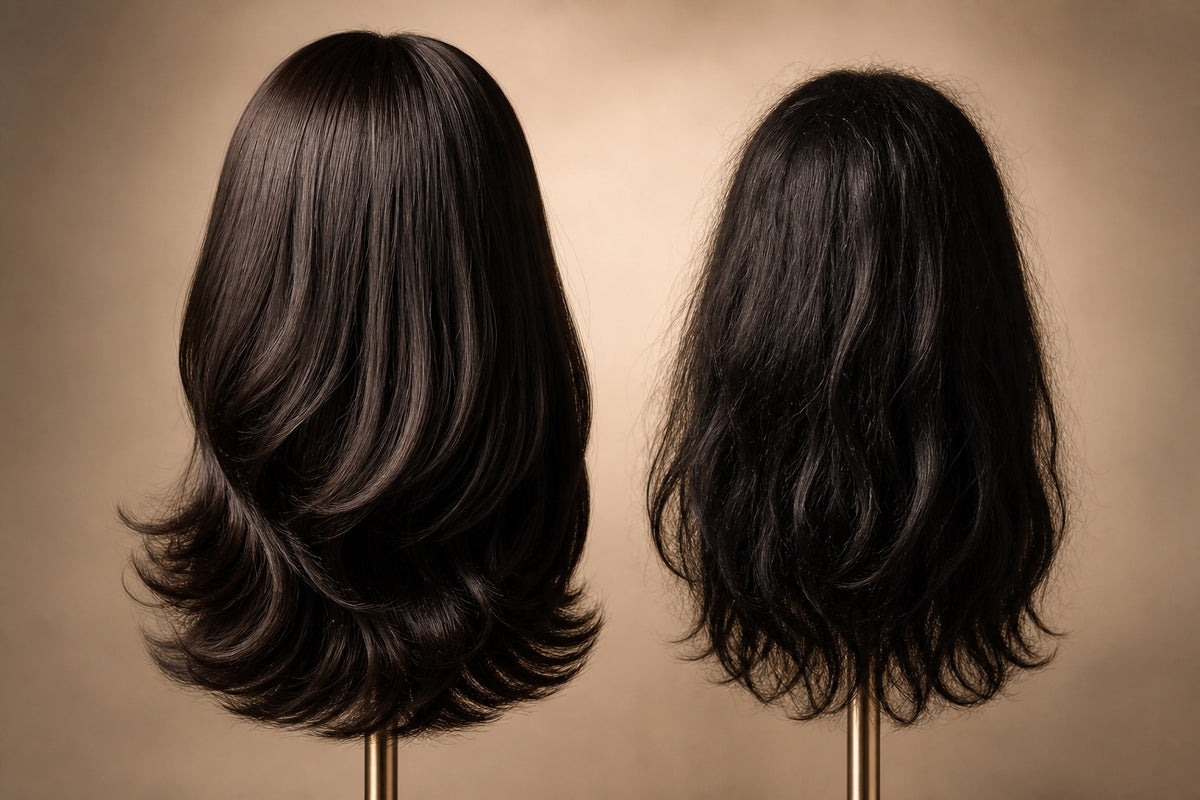
This is the single biggest swing in price. Synthetic wigs are inexpensive, come pre-styled, and hold a set — but they shine unnaturally in daylight, can’t take heat tools, and wear out fast. Human-hair wigs cost more because they behave like the hair growing from your own scalp: they take heat, color, and movement, and they last.
At PRARVI, our pieces are 100% human Indian Remy hair — cuticle-aligned, single-donor, and built to be worn, washed, and styled like your own. If you want hair you can curl, straighten, and live in, this is where the money goes. Explore natural virgin hair to see the baseline.
2. The cap: lace closure vs. frontal vs. full lace
How a wig is constructed — and how much of it is hand-tied — is the second great divider. Hand-tying strands one by one into a sheer lace base creates that gasp-worthy “hair growing from the scalp” illusion, and it is slow, skilled work.
- Closure-based wigs use a small hand-tied lace panel (typically 4x4 or 5x5) at the crown, with machine-wefted hair filling the rest. Most affordable, still natural-looking through the part. See lace closures.
- Frontal wigs use an ear-to-ear hand-tied lace front, so you can part anywhere and pull hair off your face. More lace, more labor, higher price. See frontals.
- Full-lace wigs are hand-tied across the entire cap, giving you a believable parting anywhere and the freedom of a high ponytail. The most labor-intensive build — and the priciest.
Not sure how closures and frontals differ? Our guide on lace closure vs. lace frontal breaks it down.
3. The color: why blonde costs more
Here’s a truth few brands say out loud. Hair has one natural color — Natural Black (#1B). Every lighter shade, from warm brown to icy blonde, is achieved by bleaching and lifting. That process takes time and skill, and bleaching makes hair lose weight, so more grams are needed to build the same full wig. More processing plus more raw hair equals a higher price. That’s why a blonde piece almost always costs more than the same wig in its natural dark shade. Browse blonde hair to see the lifted shades.
4. The texture: straight, wave, curl — and everything in between
Another honest note. Only three textures occur naturally: straight, natural wave, and natural curl. Every other pattern you’ve seen — deep curls, tight coils, beachy bends — is steam-set, a careful process that shapes human hair into a lasting pattern. Steam-set and curled textures take extra work, so they cost more than a basic straight wig. If you love a defined coil or curl, you’re paying for that craftsmanship. Our afro collection showcases textured options.
A note on language: shop by your hair type — fine or coarse, straight or curly — not by ethnicity. Texture and density are what actually determine your match. And while you’ll see “Brazilian” or “Peruvian” thrown around the industry, those are marketing labels; our hair’s origin is truthfully Indian. More on that in Brazilian hair vs. Indian hair.
5. Stock vs. custom (and wholesale)
How a wig is sized and sourced moves the price too:
- Stock wigs are made to standard cap measurements and ready to ship — the most budget-friendly route.
- Custom wigs are built to your head measurements, density, length, and color — more hand-work, higher cost, perfect fit.
- Wholesale per-unit pricing is lower because of volume. Salons and stylists buying at scale see better unit economics — explore wholesale hair extensions.
A note on wigs for hair loss
Wigs and toppers made for thinning hair or alopecia are often built with specialized caps and finer hand-tied detailing, which can raise the price. Important context: a PRARVI piece is a cosmetic hair piece, not a medical treatment. It can give you beautiful, natural-looking coverage and confidence, but it does not diagnose, treat, cure, prevent, or reverse any hair-loss condition. If thinning is your concern, our toppers add coverage where you want it — and our guide to extensions for thin hair is a gentle starting point.
How to spend smart
- Decide on human hair vs. synthetic first — it sets your whole budget.
- Choose the smallest lace area that gives you the parting freedom you actually need.
- Stick to natural or near-natural color if you want to save; lift adds cost.
- Order a sample to match shade and texture before you commit to a full wig.
Unsure of your match? A small swatch saves a big regret — start with a shade & texture match sample.
FAQ
Why is a human-hair wig so much more than a synthetic one? Human hair is a natural, finite material that’s collected, cleaned, cuticle-aligned, and often hand-tied. It also lasts far longer and styles like your own hair, so the cost-per-wear is often lower than it looks.
Does “virgin” mean the cheapest or most expensive option? “Virgin” means single-donor hair with no permanent dye — a quality marker, not a price tier. Note that steam-set or bleached pieces aren’t “raw” or unprocessed; we reserve those words for genuinely natural-black, natural-texture hair. See raw vs. processed human hair.
Is a more expensive wig always better for me? Not necessarily. The best wig is the one matched to your hair type, lifestyle, and budget. A well-chosen closure wig can look more natural on you than a full-lace piece you never learned to install.
Shop Human-Hair Wigs & HairAsk About Custom or Wholesale
References & further reading
Looking for a cosmetic-coverage or cranial-prosthesis wig?
Prarvi offers raw, single-donor human-hair wigs & toppers (cosmetic hair replacement) — US-based, shipped fast from New Jersey — with a one-on-one virtual fitting to get fit and color right.
