
In this article
You’ve found the perfect length, the perfect color — and then you see the words “100% human hair” on two listings with wildly different prices. Here’s how to tell what you’re actually paying for.
“100% human hair” is true of almost every extension worth buying — but it doesn’t tell you the whole story. Two bundles can both be human and still behave completely differently after a few washes, because the real difference lives in how the hair was collected and prepared. That difference has a name: Remy versus non-Remy. Get it right and your extensions look glossy for a year or more. Get it wrong and they tangle, dull, and shed within weeks.
What “Remy” actually means
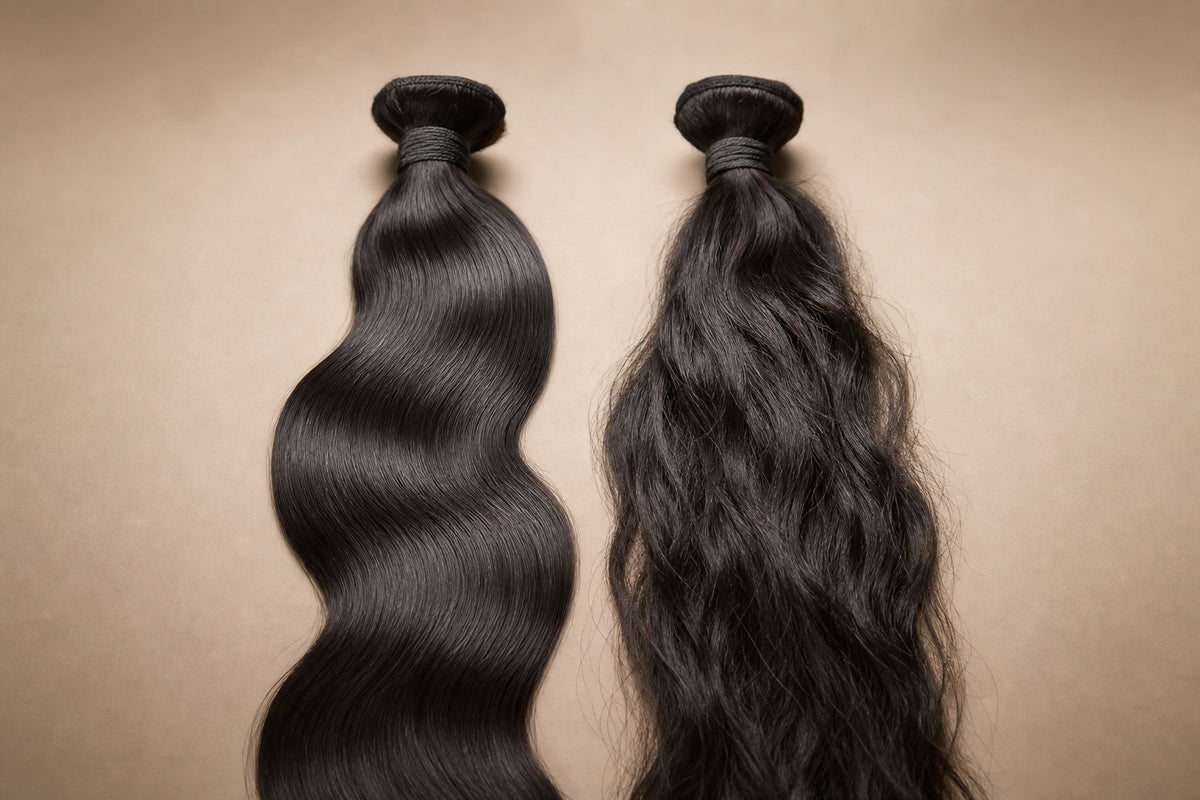
Remy refers to cuticle alignment. In Remy hair, every strand is kept running in the same direction — root-to-root, tip-to-tip — so the cuticles (the microscopic outer scales of each strand) all lie the same way. That alignment is what keeps hair smooth, reflective, and tangle-resistant over time.
- Remy hair: collected from a single ponytail or single donor, then bundled with cuticles intact and aligned in one direction.
- Non-Remy hair: also human, but gathered from mixed sources — salon-floor sweepings, brush hair, and pooled suppliers — so cuticles point every which way.
At Prarvi, our hair is ethically sourced single-donor Indian hair, gathered and bundled so the cuticle stays intact and aligned. Origin matters too: our hair is truthfully Indian — not relabeled as “Brazilian” or “Peruvian” to sound more exotic.
Why misaligned cuticles are a problem
When cuticles run in opposite directions, the strands snag on each other and tangle. To hide that, a lot of non-Remy hair is given an acid bath that strips the cuticle layer off entirely, then coated in silicone to fake a glossy finish.
It looks beautiful in the package. But silicone is a temporary disguise: after a handful of shampoos it rinses away, and what’s left is stripped, porous hair that goes dry, dull, and brittle fast. That’s why a bargain bundle can look incredible on day one and tragic by week three.
Remy vs. non-Remy at a glance
- Source: Remy = single donor; non-Remy = mixed/collected hair.
- Cuticle: Remy = intact and aligned; non-Remy = misaligned or stripped by acid.
- Finish: Remy = naturally smooth and reflective; non-Remy = silicone-coated shine that washes off.
- Longevity: Remy lasts a year or more with care; non-Remy is generally a short-term option (a few months).
- Coloring: Remy lifts and tones more predictably because the cuticle is healthy; non-Remy is already chemically stressed and reacts unevenly.
- Value: Remy costs more upfront but the cost-per-wear is lower; non-Remy is cheap to buy and quick to replace.
A quick word on “virgin,” “raw,” and color
These terms get thrown around loosely, so here’s the honest version:
- Virgin means single-donor hair with no permanent dye. It can still be steam-set into a new texture or lifted in color — and once it is, it’s no longer “raw.”
- Raw / unprocessed should be reserved for genuinely natural-texture, natural-color hair — in other words Natural Black (#1B) in its true straight, natural-wave, or natural-curl state.
- There are only three truly natural textures — straight, natural wave, and natural curl. Every other “curl pattern” you see is steam-set.
- Natural human-hair color is Natural Black (#1B). Any blonde, brown, or fashion shade is achieved by bleaching and lifting — which is fine, as long as you know that’s what makes it lighter.
Want the full breakdown? Our raw vs. processed hair guide walks through every tier so you can match the claim to the reality.
Can you dye or bleach it?
Healthy Remy hair takes color far better than stripped non-Remy hair. A few realistic expectations:
- You’ll get the cleanest results lifting only a couple of shades; dramatic platinum work stresses any extension.
- Use a developer no stronger than 20 vol where possible, and do a strand test first.
- Non-Remy hair has usually already been through harsh chemical processing, so additional bleaching often pushes it past the point of no return.
If a pre-lightened look is what you’re after, starting with professionally colored Remy hair beats bleaching a bargain bundle yourself — browse our blonde extensions for shades that were lifted with the cuticle in mind.
How to shop without getting burned
First impressions lie — fresh Remy and silicone-coated non-Remy can look identical in the package. Protect yourself before you commit:
- Order a sample first. Feel and wash a small swatch before a full install. Our shade-and-texture match service and sample hair exist for exactly this.
- Buy from a transparent seller. Ask about single-donor sourcing and whether the hair is steam-set or color-lifted. Honest answers are a green flag.
- Match the hair to your timeline. A short-term style for one event has different requirements than extensions you’ll wear daily for a year.
- Match the hair to your hair type. Choose by texture — fine, coarse, straight, wavy, or curly — so the extensions blend with your own hair, not by any other label.
Ready to feel the difference? Start with single-donor, cuticle-aligned hair in our natural virgin collection.
FAQ
Is non-Remy hair fake or synthetic? No — non-Remy can still be 100% human hair. The issue isn’t whether it’s human; it’s that the cuticles are misaligned or stripped, which shortens its lifespan and natural look.
How long does Remy hair last? With proper care — gentle washing, heat protection, and good storage — quality Remy hair can stay beautiful for a year or more, while non-Remy typically fades within a few months.
Is silicone-coated hair always bad? Silicone itself isn’t the villain; relying on it to disguise stripped, low-quality hair is. Once the coating washes out, the true condition shows.
Does buying Remy hair matter for salons? Yes — cuticle-aligned hair holds up to repeated styling and coloring, so it’s the more dependable choice for client work. Salon and bulk buyers can reach us through our wholesale program.
Shop Natural Virgin Hair Order a Sample Match
Still deciding? We’d love to help you pick the right hair for your texture and timeline — just get in touch.
Raw vs processed hair: read the full Prarvi quality guide
Compare raw, virgin, Remy, non-Remy, silicone-coated, and synthetic hair before choosing extensions for yourself, a client, or a salon order.
