
In this article
You’ve been burned before — a “virgin” bundle that tangled by week two, or a clip-in that shed like it had somewhere better to be. Here’s how to tell premium human hair from a pretty lie, before you spend a dollar.
The hair-extension world loves a buzzword. “Remy,” “virgin,” “raw” — the labels get thrown around so freely that they’ve almost stopped meaning anything. So let’s fix that. At Prarvi, our hair is 100% human Indian Remy, ethically sourced from single donors, and we’d rather teach you to inspect hair like a pro than ask you to take our word for it.
First, a little honesty about language, because clarity is the whole point of this guide.
What “virgin,” “Remy,” and “raw” actually mean
- Remy means every cuticle runs in the same direction, root to tip, because the hair was collected as a single, intact ponytail rather than gathered loose. Aligned cuticles are what keep hair smooth, shiny, and tangle-resistant over time.
- Virgin means single-donor hair that has never been permanently dyed. Important nuance: a virgin SKU can still be steam-set into a wave or curl, or gently lifted to a lighter shade — and that’s perfectly normal, premium hair.
- Raw / unprocessed is the strictest tier of all: genuinely natural-black hair (Natural Black, #1B) in its natural texture, with no steaming and no lift. Only three textures occur naturally — straight, natural wave, and natural curl. Every other texture you see is beautifully steam-set, and every shade lighter than #1B is achieved through professional bleaching or lifting. That’s not a flaw; it’s just the truth of how gorgeous, varied hair gets made.
One more truth worth stating plainly: real human hair has a single honest origin. Ours is Indian. If a seller promises “Brazilian” or “Peruvian” origin at a suspiciously low price, treat it as a flag, not a feature. Curious about the difference? Our Brazilian vs. Indian hair breakdown spells it out.
The at-home quality tests, ranked by how much they actually tell you
Grab a strand or a weft and work through these. None of them require a lab — just your eyes, your nose, and a little patience.
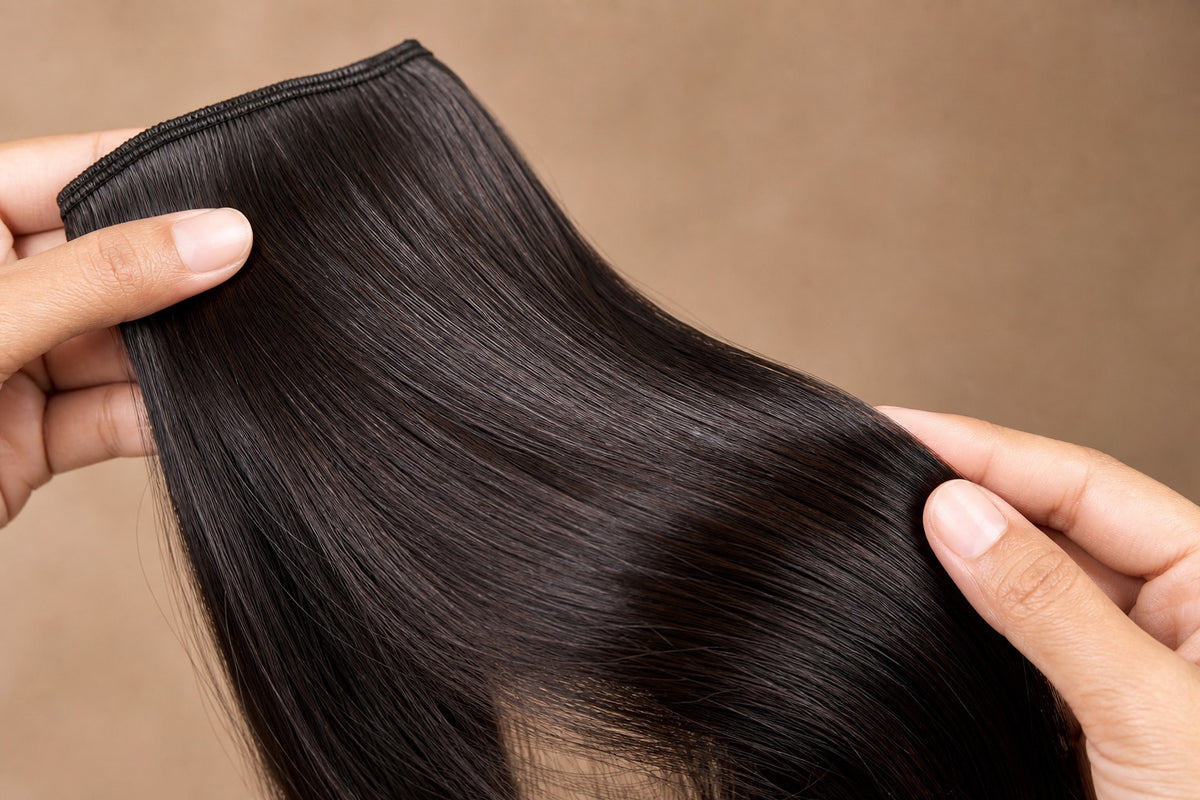
- The cuticle (feel) test. Slide your fingers down the hair from root to tip, then back up. True Remy hair feels smooth one way and slightly resistant the other — proof the cuticles are aligned. Hair that feels equally rough in both directions is non-Remy and far more likely to tangle.
- The shed & pull test. Gently tug a small section. A few stray strands are normal; a fistful is not. Run your fingers through several times — quality hair stays put. Constant daily shedding signals a weft that wasn’t sewn well or hair that was poorly collected.
- The thickness test. Hold a weft up to the light. Premium wefts are dense from top to bottom, with no thin spots or gaps and no awkward mix of long and very short hairs padding out the bundle.
- The curl-and-straighten test. Real human hair behaves like your own: it takes a curl, releases under a flat iron, and bounces back. If a strand refuses to hold a style or melts oddly, you’re likely looking at synthetic or heavily silicone-coated fibre.
- The wash test. Swish a strand in clear water. Quality hair leaves the water clear. Cloudy, tinted, or sudsy runoff means the hair was coated in silicone or dye to fake a healthy shine — a coating that washes out and leaves the hair dull.
- The smell test. Healthy human hair smells neutral, a bit like your own freshly washed hair. A sharp chemical odour points to heavy processing or coating.
- The weight test. Check the bundle against its stated weight — a standard full bundle should land around 100 g (about 3.5 oz). Coming up short often means short filler hairs were used to bulk it out.
- The length test. Reputable extensions usually measure a little longer than the labelled length. Remember that texture affects how length reads — length is always measured straight, so a curl or wave will look shorter when styled.
About the “burn test” and the “bleach test”
You’ll see these two everywhere, so here’s the measured take.
- Burn test. Genuine human hair burns quickly, curls away from the flame, turns to fine ash, and smells like singed hair. Synthetic fibre melts, beads, smells like burning plastic, and can leave a hard residue. It’s a reliable human-vs-synthetic check — just do it safely, over a sink, with a single strand and never near your installed hair.
- Bleach test. Truly virgin, healthy hair lifts evenly and stays soft when processed by a professional. We don’t recommend DIY bleaching to “test” a bundle you plan to wear — lift is a one-way street. Leave colour work to a colourist who knows extension hair.
Matching quality to the right piece — and the right hair type
The best extension isn’t about ethnicity or anyone else’s hair — it’s about matching texture and density to your hair type, whether that’s fine, coarse, straight, wavy, or curly. A few starting points:
- Want untouched, natural-texture hair? Start with our natural virgin collection.
- Dreaming in lighter shades? Our blonde extensions are professionally lifted for an even, soft result.
- Building a seamless install? Compare a lace closure vs. a frontal, then shop closures or frontals.
- Fine or thinning hair? Our guide to extensions for thin hair walks you through gentle, low-tension options like tape-ins and toppers.
The smartest test of all: order a sample
You can run every test above in your own bathroom before committing to a full set — and we’d encourage it. Order a hair sample or use our shade & texture match service to feel the cuticle, check the shine, and confirm the colour against your own hair in natural light.
FAQ
Does “Remy” guarantee top quality? It guarantees aligned cuticles, which is a strong foundation — but weft construction, sourcing ethics, and how the hair was processed all matter too. Use the tests above to confirm.
Can virgin hair still be curly or blonde? Yes. Virgin means single-donor and never permanently dyed. That hair can be steam-set into a wave or curl, or professionally lifted to a lighter shade, and remain virgin. Only natural-black (#1B), natural-texture hair qualifies as truly raw and unprocessed.
Should I really do the burn test on hair I bought? Only on a single spare strand, safely over a sink — never on installed hair. It’s the clearest way to separate human hair from synthetic, but it destroys the strand you test.
How can a salon vet hair before placing a bulk order? Request samples first, run the cuticle, wash, and burn tests, then talk to us directly about your clients’ needs. See our wholesale program.
Order a hair sample Talk to a hair expert
References & further reading
Shopping for raw single-donor Indian hair?
Bundles, closures, frontals, wigs & toppers — raw, single-donor Indian hair, US-based and shipped fast from New Jersey. Not sure what to pick? We'll help you match texture and length.
