
In this article
You want to launch a hair line — or simply buy extensions you can trust — but the supply chain is a maze of foreign vendors, vague labels, and claims that don’t survive a second look. Here’s what the industry would rather you didn’t know.
Sourcing human hair is harder than it should be. The vendors often speak a different language, the product is genuinely difficult to tell apart by eye, there are very few trusted brands, and honest suppliers with real control of their own supply chain are rare. Whether you’re a salon owner building a wholesale program or a shopper trying to spend smart, knowing how the raw material actually moves is your best protection.
First, the language problem: what the labels really mean
Half the confusion in this market comes from loose terminology. Let’s set the record straight before we go further.
- Virgin means single-donor hair that has never been permanently dyed — not a magic quality grade. A virgin bundle can still be steam-set into a wave or curl, and it is still virgin.
- Raw / unprocessed is a stricter claim. Reserve it for hair that is genuinely Natural Black (#1B) in its natural texture, with no steam-setting and no lift. If a bundle has been bleached to a lighter shade or steam-set into a pattern, it is processed — honest sellers say so.
- Remy means the cuticles are intact and aligned root-to-tip in one direction. This is what keeps hair from tangling and matting over months of wear.
- Origin is origin. Prarvi hair is Indian Remy — not “Brazilian” or “Peruvian” relabeled for marketing. Those names describe a look, not a country of harvest.
For the longer version of how processing changes a bundle, see our guide to raw vs. processed human hair.
Truth #1: Genuine virgin hair is a small slice of the market
True single-donor virgin hair represents only a small fraction of total global hair production. That scarcity is exactly why so many listings claim “virgin” when the bundle inside is actually lower-grade, multi-donor non-Remy hair. On the largest open marketplaces, a “virgin” label is a marketing word as often as it is a fact. The cuticles may be stripped and the hair acid-bathed and silicone-coated to feel smooth in the package — until the first few washes, when it tangles and sheds.
The test isn’t the label. It’s whether the seller can tell you the donor story, the texture, the exact shade, and whether it was steam-set or lifted — and whether they’ll let you order a sample to shade- and texture-match before you commit.
Truth #2: “Dyed” stock gets quietly mixed in
When vendors buy hair in bulk, the lot includes more than clean, uniform color. A meaningful share of any purchase arrives already colored or gray, and that stock is hard to move on its own. Scrupulous companies separate it out and sell it transparently. Less scrupulous ones blend dyed strands into the weft to clear inventory — which is why a bundle can look consistent on arrival and then reveal mismatched, brassy, or porous sections after washing.
This matters for your color work. Hair that was already lifted or dyed before you bought it behaves unpredictably under the chair. If you want a lighter result, buy from a seller who is honest about what was bleached and what wasn’t — our blonde extensions are lifted intentionally and labeled as such, never passed off as “raw.” For shades that are kept genuinely natural, start with the natural virgin collection.
Truth #3: Single drawn vs. double drawn is a real, visible difference
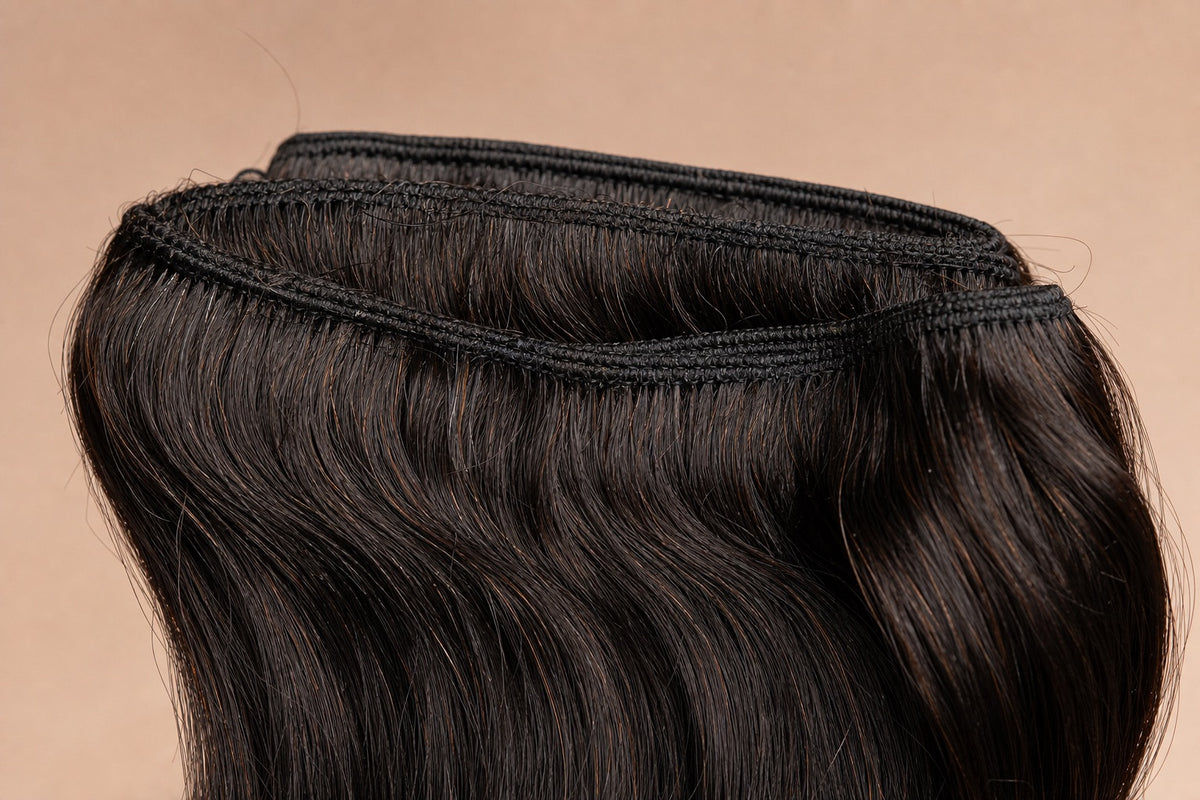
Virgin hair is typically collected and sold single drawn — meaning the bundle keeps its natural mix of lengths, so it’s fuller at the top and tapers toward the ends, just like hair grows. Lower-grade hair is often processed into double drawn, where shorter strands are pulled out so every strand hits the same length and the bundle looks uniformly thick top to bottom.
Neither is “bad,” but they are not the same product:
- Single drawn — natural taper, lighter feel, the realistic look most clients want for everyday wear.
- Double drawn — uniform thickness end to end, heavier, more expensive to produce, often favored for dramatic volume.
If a “virgin” bundle is perfectly even from weft to tip, ask why. Uniformity is a sign of processing, not purity.
Truth #4: Texture and color are usually engineered — and that’s fine, if it’s disclosed
There are only three truly natural textures in human hair: straight, natural wave, and natural curl. Everything else — deep waves, defined curls, sleek bone-straight patterns — is steam-set. Likewise, Natural Black (#1B) is the only natural color; every lighter shade is achieved by bleaching and lifting. None of that makes a product inferior. It only becomes a problem when a seller hides it and charges “raw” prices for processed hair.
How to buy like an insider
- Sample before you scale. Never place a large order off a photo. Match shade and texture in hand first.
- Buy by hair type, not by country or ethnicity. What matters is whether your client’s hair is fine or coarse, straight or curly — choose extensions that blend with that, not a marketing label.
- Ask the processing question directly. “Is this steam-set or natural texture? Was it lifted or is it #1B?” A confident, specific answer is a good sign.
- Watch the weft, not the wrapper. Inspect for mixed strands, inconsistent length, and cuticle direction.
- Work with one accountable source. A supplier who controls their own chain can stand behind every claim — and reorder consistency is everything in a salon program.
Frequently asked questions
Is “virgin” the same as “raw”? No. Virgin means single-donor with no permanent dye. Raw is stricter — genuinely Natural Black, natural texture, no steam-setting or lift. A virgin bundle can be steam-set or bleached; a raw one cannot.
Why does cheap “virgin” hair tangle after a few washes? Often because the cuticles were stripped and the hair was coated to feel smooth in the package. Once the coating washes out, non-Remy hair with misaligned cuticles mats and sheds.
Is Indian hair really different from “Brazilian” hair? Origin labels like Brazilian or Peruvian usually describe a look, not a harvest country. We compare the realities in our Brazilian vs. Indian hair guide.
Can I get a lighter color without buying mystery dyed stock? Yes — buy hair that was intentionally and transparently lifted, like our labeled blonde range, rather than a “raw” bundle with hidden dyed strands.
Build your program on hair you can vouch for
Whether you’re stocking a salon or buying for yourself, the right move is the same: sample first, ask the hard questions, and work with a source that controls its own supply chain.
Explore Wholesale Order a Sample
References & further reading
Stylist, salon, or reseller?
Prarvi supplies raw, single-donor Indian hair wholesale — bundles, closures, frontals & wigs — shipped fast from New Jersey. We start with a quick consult to match your clients, and paid sample kits let you vet quality first.
