
In this article
You’ve clicked “add to cart” on a bundle that looked gorgeous in the photo — only to have it tangle, shed, or refuse to blend by week two. Let’s make sure that never happens again.
Shopping for virgin hair extensions can feel like decoding a secret language: single drawn, double weft, Remy, single donor. We’ve spent years sourcing 100% human Indian Remy hair, and the truth is that a handful of specs separate a bundle you’ll love for a year from one you’ll quietly toss in a month. Here’s exactly what to look at before you buy — whether you’re shopping online or standing in a salon.
First, what “virgin” actually means
“Virgin” means the hair comes from a single donor and has never been permanently dyed. It does not automatically mean “raw” or “unprocessed.” In nature, human hair comes in only three textures — straight, natural wave, and natural curl — and one natural colour, Natural Black (#1B). Any other wave pattern is gently steam-set, and any lighter shade is achieved by lifting or bleaching. So a bundle can be 100% virgin and still be steam-set or pre-lightened. If you want the genuinely untouched version, look specifically for raw, natural-black, natural-texture hair. (Curious about the difference? Read raw vs. processed human hair.)

The 8 factors that decide bundle quality
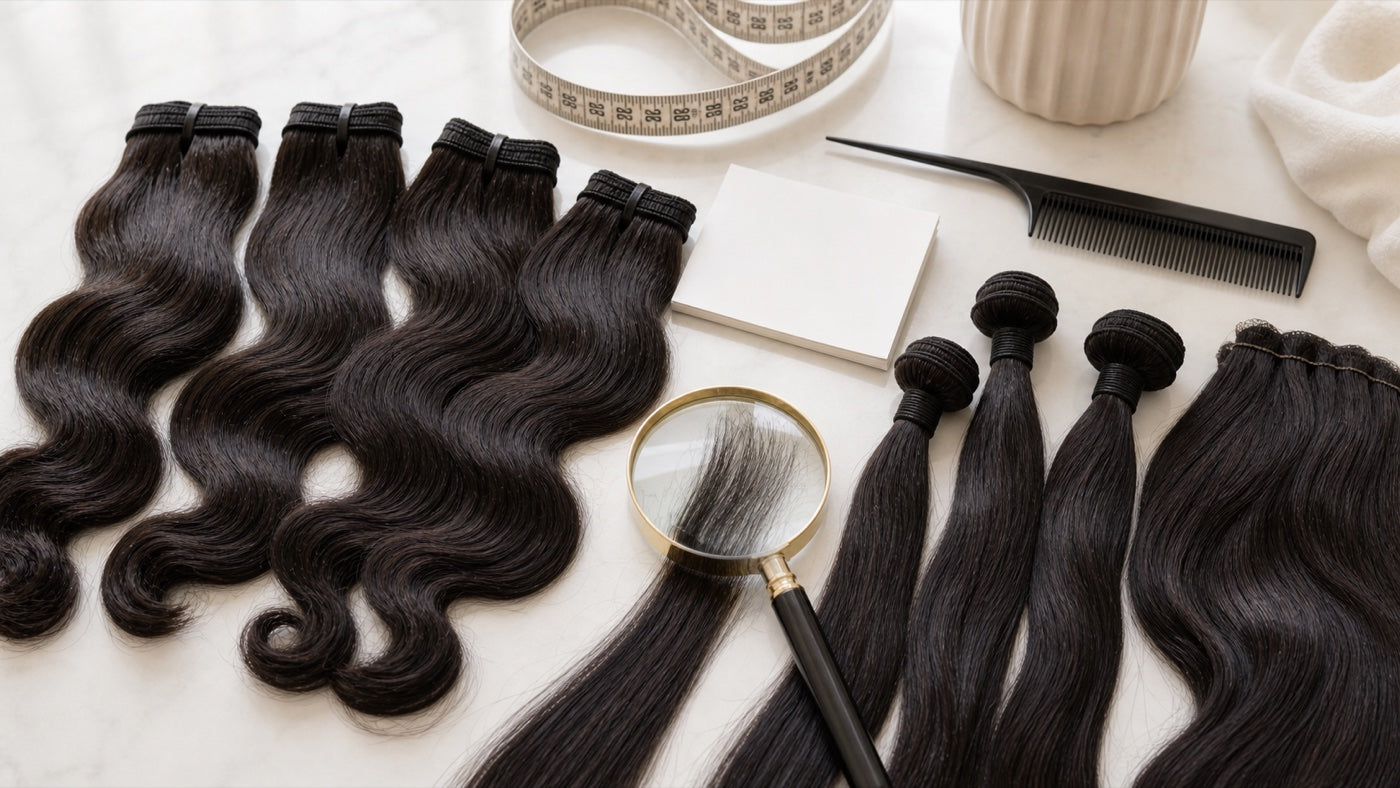
- Wefts — single or double stitch? The very first thing to ask. A double-stitched weft holds the hair more securely, which means dramatically less shedding over time. It’s the difference between a weft that lasts and one that sheds onto your shoulders by month two.
- Weight — is it a full bundle? A standard sew-in bundle weighs about 100 grams (3.5 oz). Some sellers quietly shave grams to drop the price. Before you celebrate a deal, ask the real question: “Is this bundle cheaper because it actually weighs less?”
- 100% human hair vs. synthetic blend. Real human hair can be washed, heat-styled, and coloured like your own — and it lasts. A synthetic blend only makes sense if you want a trendy look for one or two wears. For anything you’ll live in, choose 100% human virgin hair.
- Remy vs. non-Remy. This is the tangle test. In Remy hair, every cuticle faces the same direction (root-to-tip), so the hair stays smooth and matt-free. Non-Remy hair mixes cuticle directions and tangles fast. If you want low-maintenance, choose cuticle-aligned Remy — every time.
- Single donor vs. multiple donors. Single-donor hair comes from one person, so the texture and quality are consistent from weft to weft — it moves and feels like your own. Multi-donor bundles blend hair from many sources and can behave unpredictably across the same install.
- Single drawn vs. double drawn. Single drawn (the most common in the U.S.) has naturally varied lengths, so it tapers at the ends like real hair grows. Double drawn has the shorter strands removed by hand, giving you thick, full ends all the way to the tip — which is why it costs more. Neither is “better”; it depends on the look you want. We break it down in single drawn vs. double drawn.
- Can it be coloured or lightened? The best-quality virgin hair will lift cleanly all the way to a #613 blonde without falling apart. If you have no plans to colour, you can often choose a more affordable option. If you do, quality matters — cheap hair scorches and snaps under bleach. See how true lifting hair behaves in our blonde extensions.
- How well does it style? Good human hair shouldn’t fight you. The best virgin extensions take a curl, hold a sleek blowout, and adapt to most looks — because they behave like the hair already growing from your scalp.
A quick word on matching
Here’s the trade secret: the single biggest reason an install looks “off” isn’t the hair quality — it’s a mismatch in shade or texture. Choose extensions by your own hair type (fine, coarse, straight, wavy, curly) rather than by any assumption about background or origin. The most reliable way to nail it is to order a swatch first and match it in your own light. Try our shade & texture matching samples before you commit to a full set.
Frequently asked questions
Is virgin hair the same as raw hair? Not quite. Virgin means single-donor and never permanently dyed. Raw means genuinely unprocessed — natural black, natural texture, no steam-setting or lifting. A steam-set or pre-lightened bundle can be virgin but is not raw.
Where does Prarvi hair come from? Our hair is ethically sourced single-donor Indian Remy hair. We’re always honest about origin — you’ll never see us label Indian hair as “Brazilian” or “Peruvian.” Learn more about Indian Remy hair.
How do I avoid shedding and tangling? Look for double-stitched wefts (less shedding) and cuticle-aligned Remy hair (less tangling). Those two specs do most of the heavy lifting.
Should I pay more for double drawn? Only if you want maximum thickness from root to tip. For a natural, tapered look, single drawn is beautiful — and easier on the budget.
The bottom line
Don’t make a rushed decision. Know what you want first — then check the wefts, weight, Remy status, donor source, and how the hair lifts. A few minutes of homework now saves you weeks of frustration later. When you’re ready, start with a sample and match it to your own hair.
Shop Virgin HairOrder a Shade & Texture Sample
References & further reading
Shopping for raw single-donor Indian hair?
Bundles, closures, frontals, wigs & toppers — raw, single-donor Indian hair, US-based and shipped fast from New Jersey. Not sure what to pick? We'll help you match texture and length.
