
In this article
Before you fall for a single extension, topper, or wig, your hair has one question it wants answered first—what’s my texture? Get that right, and everything from your install to your blowout gets easier.
Why Hair Texture Is the Starting Point for Everything
Texture is the quiet variable behind every great—and every disappointing—hair decision. It’s determined by the diameter of each individual strand (its circumference) and the condition of the cuticle, the protective outer layer. Fine strands have a small circumference and a tightly closed cuticle. Coarse strands have a large circumference and a cuticle that sits more open, which makes the hair more porous and thirstier for moisture.
One important note up front: texture is not the same as curl pattern, and it is never about ethnicity or race. Fine, medium, and coarse describe the thickness of the strand—you can have fine curly hair or coarse straight hair. When you shop by your real hair type instead of a label, you match your extensions far more accurately.
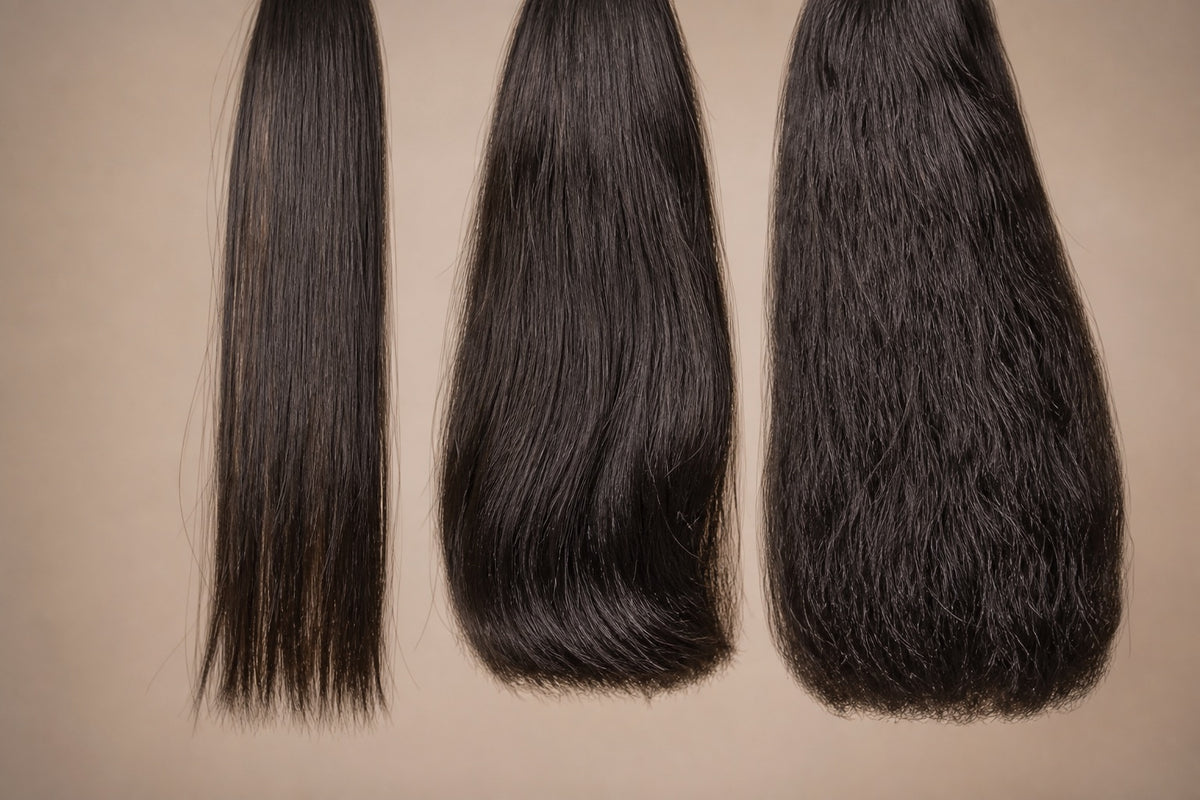
The Three Hair Textures, Decoded
Fine Hair
- Looks almost translucent when you hold a strand up to the light.
- Rolled between your index finger and thumb, it’s barely there—like a single thread of silk.
- Has just two structural layers: the cuticle and the cortex.
- Reads thin, can break more easily, and is more prone to damage.
- Smooth and shiny, but it struggles to hold a style for long.
- Tends to run oilier than other textures and can be over-moisturized fast, so go light on heavy products.
If this is you, lightweight, seamless attachment methods are your friends. Explore tape-in extensions and micro-link extensions, and read our guide to extensions for thin or fine hair.
Medium Hair
- The middle ground—neither coarse nor fine.
- Rolled between your fingers it feels like a cotton thread: not stiff, not flimsy.
- Has the cuticle and cortex, and may also have a medulla (the innermost core).
- More resilient—it doesn’t break as easily.
- Holds a natural bounce and takes most styles willingly.
Medium hair is the most versatile canvas. Nearly every method works, from lace closures to toppers.
Coarse Hair
- Rolled between your fingers, it feels wiry and firm—you can actually hear it move.
- The strongest texture of the three, thanks to the largest strand circumference.
- Has all three layers: cuticle, cortex, and medulla.
- Heavier and more textured—it holds elaborate styles beautifully.
- Rich in protein, which can tip into dryness or brittleness, so seal in moisture and don’t skip your deep conditioner.
Coarse and curly hair pairs best with fuller, robust pieces. Browse the afro-texture collection and our lace frontals for a seamless blend.
How to Test Your Own Texture in 10 Seconds
- Take one clean, dry strand of shed hair.
- Roll it slowly between your index finger and thumb.
- Can’t feel it at all? Fine. Feels like a soft thread? Medium. Feels wiry, almost audible? Coarse.
- Still unsure? Compare it to a strand of sewing thread—your hair will sit thinner, similar, or thicker.
Knowing your texture makes every other choice easier: which products to reach for, which styles will actually hold, and—crucially—which extensions will disappear into your own hair. The surest way to nail the match is to feel it in hand. Order a hair sample or use our shade and texture match service before you commit.
A Quick Word on “Texture” in Extensions
When we talk about extension texture, it’s worth knowing the truth behind the labels. Only three textures occur naturally in human hair—straight, natural wave, and natural curl. Every other pattern you see (deep wave, kinky curly, body wave) is steam-set into the hair. Likewise, the only natural color is Natural Black (#1B); every lighter shade is achieved through professional bleaching and lifting. PRARVI hair is truthfully sourced single-donor Indian Remy—not Brazilian or Peruvian, despite what those marketing terms suggest elsewhere. Learn more in our raw vs. processed human hair explainer.
Frequently Asked Questions
Is hair texture the same as hair type? Not exactly. Texture refers to the thickness of each strand (fine, medium, coarse), while “type” is often used loosely to also include curl pattern. For matching extensions, you’ll want to consider both your texture and your curl pattern together.
Can my hair texture change over time? Yes. Hormones, age, heat damage, and color processing can all shift how your strands feel. It’s worth re-checking your texture every so often, especially if your usual products suddenly stop working.
How do I match extensions to my texture? The most reliable method is a physical comparison. Order a sample or use our shade and texture match service so you can hold both side by side before buying.
Find Your Perfect Match
Shop Natural Virgin HairMatch My Texture
References & Further Reading
Shopping for raw single-donor Indian hair?
Bundles, closures, frontals, wigs & toppers — raw, single-donor Indian hair, US-based and shipped fast from New Jersey. Not sure what to pick? We'll help you match texture and length.
