
In this article
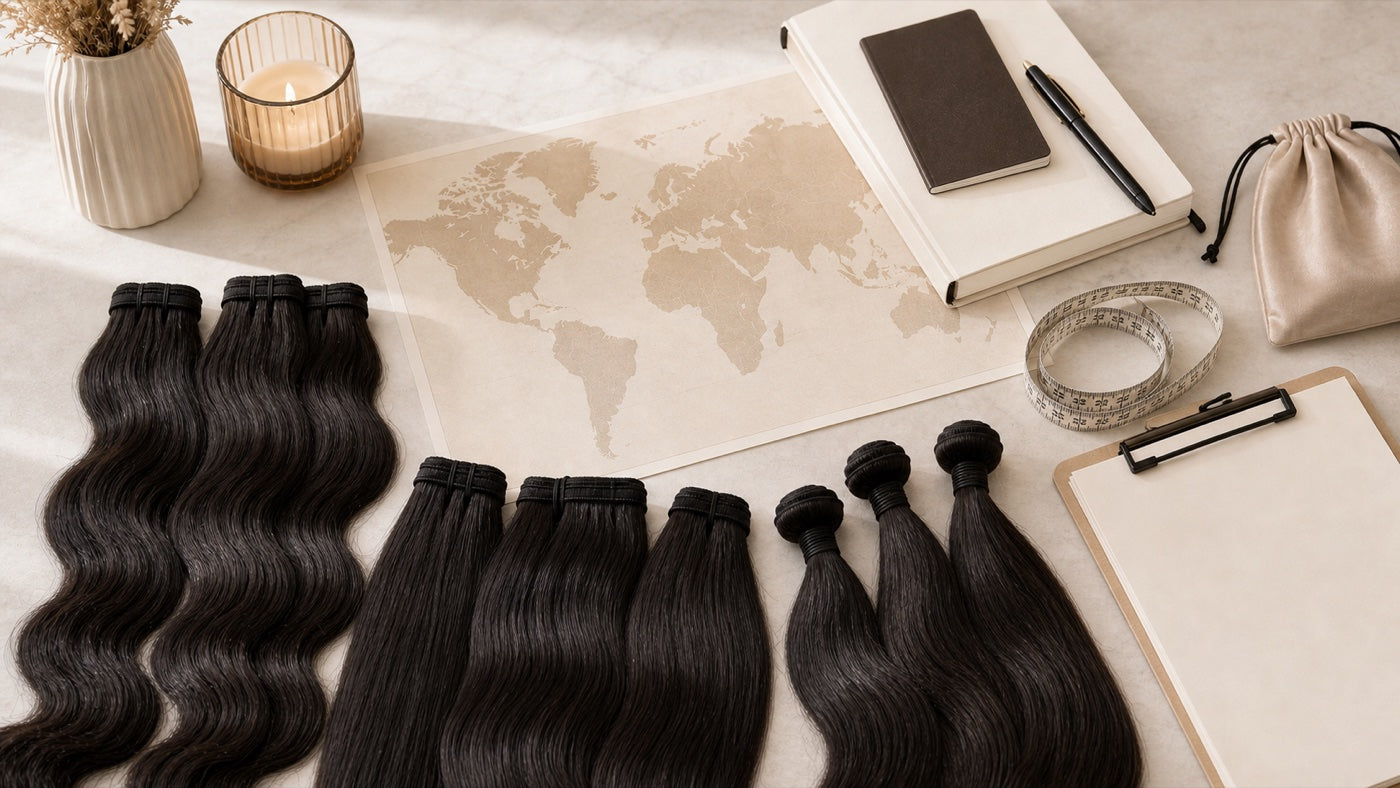
A country name on a hair-extension listing does not necessarily tell you where the hair was collected. Collection, processing and manufacture can happen in different places. Brazilian, Indian, Peruvian or Malaysian wording therefore needs an explanation from the seller: is it describing collection origin, processing, or a familiar style?
For a sense of how far those meanings can diverge, look at India's 2024 export record. Of $185.88 million in unworked human hair and hair-waste exports, $185.38 million went to Myanmar—99.73% by value. That is a customs finding, not a claim that almost every finished extension contains Indian hair. Source: India-reported exports, HS 050100, 2024, WITS/UN Comtrade.
Before the border: how hair enters the trade
In a 2018 ABC News report from Vietnam, student Thien Y sold her hair to help pay university expenses. Another interviewee, Linh, described arranging a sale through Facebook after a salon haircut. These are documented individual experiences, not a current price guide or a measure of how all Vietnamese hair is collected. Zoe Osborne, ABC News, November 2018.
That is one starting point. Published research and reporting describe several others:
- Hair cut for sale: a person sells a length of hair to a buyer or collector. The sale and the later export are different transactions.
- Religious donations: hair offered during temple tonsuring can enter an organised collection and auction system. Goldsmiths' account of anthropologist Emma Tarlo's research describes temple collection in India alongside other supply channels. Goldsmiths, October 2016.
- Collected shed hair: Tarlo's 2016 interview described household collectors and workers untangling combed-out hair in parts of India, Bangladesh and Myanmar. This establishes a collection route, not its present market share or the history of an individual product. The World / GBH, November 2016.
These routes are not three quality grades. Collection history, donor mixing, subsequent treatment and finished construction are separate questions. Nor does this reporting establish which route supplies most extensions today.
Small-scale collection can feed a formal export business: hair may pass through household collectors, local buyers and processors before it appears in a customs declaration. That makes collection difficult to measure from trade tables alone. An informal collection network is not, by itself, evidence of illegal exports. The collection routes documented in the reporting above and the border transactions measured by customs describe different parts of the same business.
From collection to the finished hair extension
It helps to separate four business stages. A supplier may perform several, and a border need not separate each stage.
- Collection: hair enters a supply network. Establishing where a particular lot was collected requires sourcing records, not simply an export-country name.
- Preparation: material is made suitable for the intended product. Ask which sorting, washing, colouring or other processing has actually been performed.
- Manufacture: hair is made into a weft, tape-in, tipped extension, closure, topper or wig. The assembly location need not be the collection location.
- Distribution: a finished product reaches importers, brands, stylists and customers. A seller's business address is a separate fact again.
Collection → preparation → manufacture → distribution describes stages, not a traced shipment. Customs tables do not follow an individual bundle through every operation.
Preparation can also change the alignment of collected hair. A published Chinese patent describes a machine that uses friction and the directional structure of cuticle scales to separate strands facing opposite ways. This is mechanical sorting, not chemical cuticle removal. It documents a mechanism—not how widely it is used or the performance of every product sold as “machine Remy.” Alignment alone does not establish single-donor sourcing or an untreated history. CN207011767U, published February 2018.
Why temple sales are different from total exports
A temple auction is a domestic sale of collected material. An export records goods crossing a border, possibly after preparation and resale. They are not interchangeable measures of the hair market. Do not add temple receipts to national exports or divide unlike figures to infer the proportion of exported hair that came from temples.
For a concrete example, TTD reported revenue of ₹47.92 crore from its 24 November 2022 hair auction. That is one institution’s dated auction result—not India’s annual hair exports or an estimate of today’s market. TTD’s auction announcement.
Likewise, a particular auction's proceeds, a temple's annual receipts and its next year's budget projection answer different questions. Any comparison needs the same period and clearly stated coverage.
Why a bulk auction price is not the price of selected hair
Total hair collected is not the same as hair available at a particular length and quality. TTD’s 15 May 2014 auction offered 114,000 kg across its categories, but only 700 kg was in the approximately 31-inch-and-above category. Another 50,000 kg was under five inches. That dated stock list illustrates why total tonnage can greatly overstate the material available to a buyer seeking long hair; it is not a current or annual supply distribution. TTD’s category-by-category auction results.
Auction categories already separate broad lengths and other characteristics, but a broad grade is not a promise that every strand has the same length or condition. Buying several bags of graded material is a different purchase from ordering only selected long strands. Requiring a particular natural curl and acceptable condition further narrows the eligible material. Sorting cannot turn the shorter portion into long hair, or make every long strand suitable for the same finished product.
The pricing implication is straightforward: a supplier’s quote for selected long or naturally curly hair can be substantially higher than the average paid for a broader mix. It reflects the selected material, usable yield, sorting and preparation—not simply the weight originally bought. Comparisons need matching length distribution, texture, condition and processing stage. The auction records do not quantify the combined long, high-quality, naturally curly subset or establish a current price premium for it.
Which countries supply finished human-hair products to the United States?
The US reported $768.9 million of imports under HS 670420 in 2024, including $660.4 million from China, about 85.9% by value. The category covers human-hair wigs and other human-hair articles; it is not a count of extension bundles or a measure of retail spending.
Other suppliers in that US table include Indonesia, Vietnam, Bangladesh and Cambodia. Their presence matters: a raw-hair export ranking is not a finished-product manufacturing map. Nor does the partner country in a customs table establish the donor's country. Source: US-reported imports, HS 670420, 2024.
America is important, but it is not the whole market
China reported $3.555 billion in exports of finished human-hair articles in 2024. Its own records put the US at $2.206 billion, or 62.05%. Nigeria, Ghana, South Africa, the United Kingdom and the Democratic Republic of the Congo were other substantial destinations. Source: China-reported exports, HS 670420, 2024.
Notice that China's declared exports to the US exceed the US-declared imports from China. These are two countries' records of bilateral trade, not numbers that should be averaged into a supposedly more accurate total. Classification, coverage, partner assignment, timing and valuation need investigation before explaining the disagreement. The gap alone is not proof of smuggling.
A country name can do five different jobs
- Collection origin: where the hair was collected.
- Processing location: where it was prepared or treated.
- Assembly location: where the finished piece was constructed.
- Customs origin: the origin assigned under the applicable customs rules; do not assume it always equals the final assembly location.
- Style name: wording used to describe an appearance or texture rather than a documented geographic source.
Those distinctions apply to Indian hair as well as Brazilian, Peruvian or Malaysian labels. Ask what the seller means and what supports the answer. A country name alone neither proves quality nor establishes that a product has been mislabelled.
What trade figures cannot tell you about your bundle
Country totals do not establish whether a particular piece is Remy, virgin, single-donor, cuticle-aligned, naturally textured or double drawn. A national average price per kilogram does not identify the grade of an individual bundle. Collection, processing history and construction need their own evidence.
For buying decisions, start with the materials used in extensions, then compare length distribution and fullness. Ask for the actual unit of sale, mass, length, processing information and care instructions.
How to read the numbers
The figures above are dated 2024 observations, not a forecast or a claim to describe 2026 trade. WITS displays monetary values in thousands of US dollars; the article converts them into millions or billions. Shares are calculated within the same country's reporting table.
HS 050100 covers unworked human hair and waste. HS 670420 covers human-hair articles. Neither should be confused with all wigs, synthetic hair, prepared mixed-material wig-making inputs or consumer spending. The stages can include overlapping material, so their export totals are not additive.
Updated September 2026 with 2024 trade data.
Explore the hair-origin story further
- Who buys human-hair products? The 2024 trade data — destinations and the difference between imports and exports.
- What hair extensions are made from — the materials question, separate from country labels.
- Single versus double drawn hair — why length distribution and fullness are different from geographic origin.
Read the collection story and the customs record together: one explains how material enters a supply chain; the other records trade across borders. Neither alone traces the piece in a customer's hand.
