
In this article
That bundle labeled “virgin Brazilian” tells you a story — but does the supply chain back it up? Here’s how to read between the lines before you buy.
If you’ve shopped for extensions, wigs, or wefts, you’ve seen the buzzwords: virgin, Remy, raw, plus a parade of country names. Most shoppers assume those labels are tightly regulated. They aren’t. A lot of what gets sold as premium “virgin” hair is actually non-Remy hair dressed up in a more glamorous origin story — and once you understand where real virgin hair actually comes from, the math stops adding up.
Where real Indian virgin hair actually comes from
The bulk of genuine, high-quality Indian hair is sourced from temple auctions, where devotees offer their hair and the temples sell it in bulk. Hair companies buy at auction, then clean, wash, and prepare it for the market — and a large share of that supply is imported into the U.S. and Europe.
Here’s the catch. The hair sold at the temple source amounts to roughly $30–40 million a year. Yet U.S. hair-product imports alone run well over $1.5 billion. India exported around $317 million of raw hair in 2015. So if temple hair is a relatively small, expensive slice of the pie… where is the rest of it coming from?
The non-Remy sleight of hand
A large part of the supply comes from raw hair exports that are non-Remy — meaning the cuticles aren’t kept aligned root-to-tip. This hair is frequently processed in China, where it’s often coated in silicone to feel smooth and silky in the package. It looks gorgeous on day one. Then a few washes strip the coating, the misaligned cuticles tangle and mat, and the shine you paid for disappears.
The marketing fix? Rebrand it. Cheaper non-Remy hair routinely re-emerges under aspirational geographic names — “Brazilian,” “Peruvian,” “Malaysian.” The reality is that very few countries export meaningful volumes of virgin hair, and most of these names tell you nothing reliable about the actual origin.
Decode the labels (the honest version)
- Virgin — single-donor hair with no permanent dye. Important: virgin is not the same as “untouched.” A virgin SKU can still be steam-set into a new texture or bleached to a lighter shade.
- Remy — the cuticles are intact and aligned in one direction, which is what keeps hair tangle-resistant and long-lasting. Non-Remy reverses or mixes cuticle directions, so it mats over time.
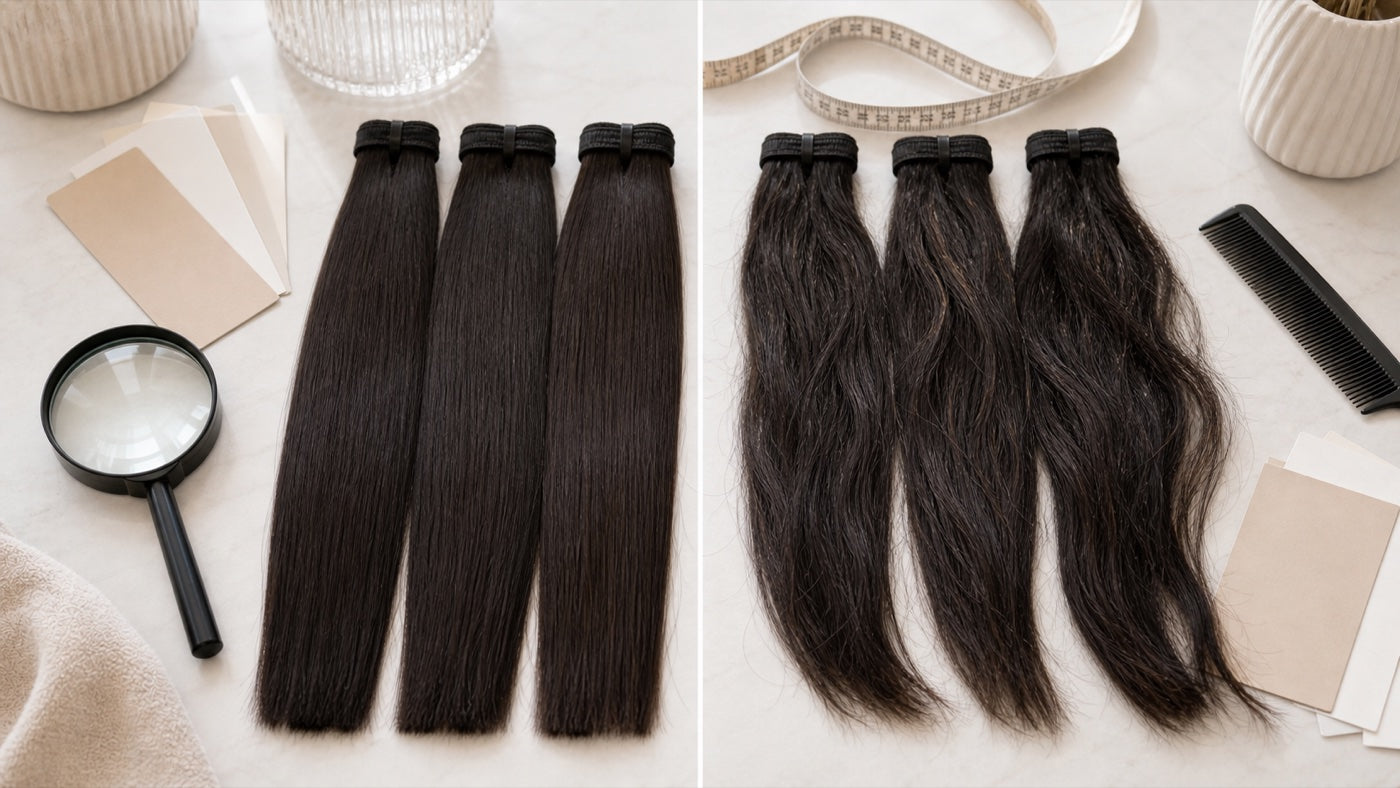
- Raw / unprocessed — reserve these words for hair that is genuinely natural in its texture and color. At Prarvi, the only truly natural textures are straight, natural wave, and natural curl, and the only natural color is Natural Black (#1B). Anything in another shade has been lifted or bleached; any other texture has been steam-set. Those SKUs are beautiful — but they are not “raw.”
- A country name on its own — not a quality spec. Ask whether that country actually exports hair at the volume being sold.
We frame hair by type — fine, coarse, straight, wavy, curly — because that’s what determines how a bundle behaves, blends, and wears. For a deeper breakdown, see our guide on Indian Remy hair and our honest comparison of Brazilian vs. Indian hair.
How to protect yourself as a buyer
- Be skeptical of geography. If a label leans hard on a country name, check it against export data. Does that country truly export hair in volume?
- Ask about Remy status and processing. A reputable seller will tell you whether hair is Remy, single-donor, steam-set, or bleached — not hide behind a flag.
- Do the silicone test. Suspiciously slippery, ultra-shiny hair can be coated. Wash a small section a few times and watch for tangling or matting.
- Order a sample first. The cheapest insurance against a bad bundle is matching shade and texture before you commit. Try our shade & texture match samples or browse the sample collection.
At Prarvi, our origin is simply, truthfully Indian — no borrowed country names. We’ve also been developing testing methods for hair authenticity alongside scientists and experts, because we believe verifiable quality should replace vague marketing. (More on that in future posts.) If you work with hair scientifically or have ideas on testing, we’d genuinely like to hear from you.
Frequently asked questions
Is “virgin” hair always unprocessed? No. Virgin means single-donor with no permanent dye, but it can still be steam-set into a new texture or bleached to a lighter shade. Only natural-black, natural-texture hair should be called raw or unprocessed.
Does “Brazilian” or “Peruvian” tell me where my hair is from? Usually not. Those names are largely marketing. Very few countries export virgin hair in meaningful volumes, and a lot of what carries those labels is non-Remy hair processed elsewhere.
Why does some hair tangle after a few washes? Often because it’s non-Remy — the cuticles aren’t aligned — and a silicone coating masked the problem until washing stripped it away. Remy, cuticle-aligned hair holds up far better.
How can I be sure before I buy? Order a sample to confirm shade and texture, ask the seller about Remy status and processing, and treat country names as a story, not a spec.
Not sure what you’re really buying? Start here.
Match your shade and texture with a real sample, or read the full Prarvi quality guide comparing raw, virgin, Remy, non-Remy, and silicone-coated hair.
